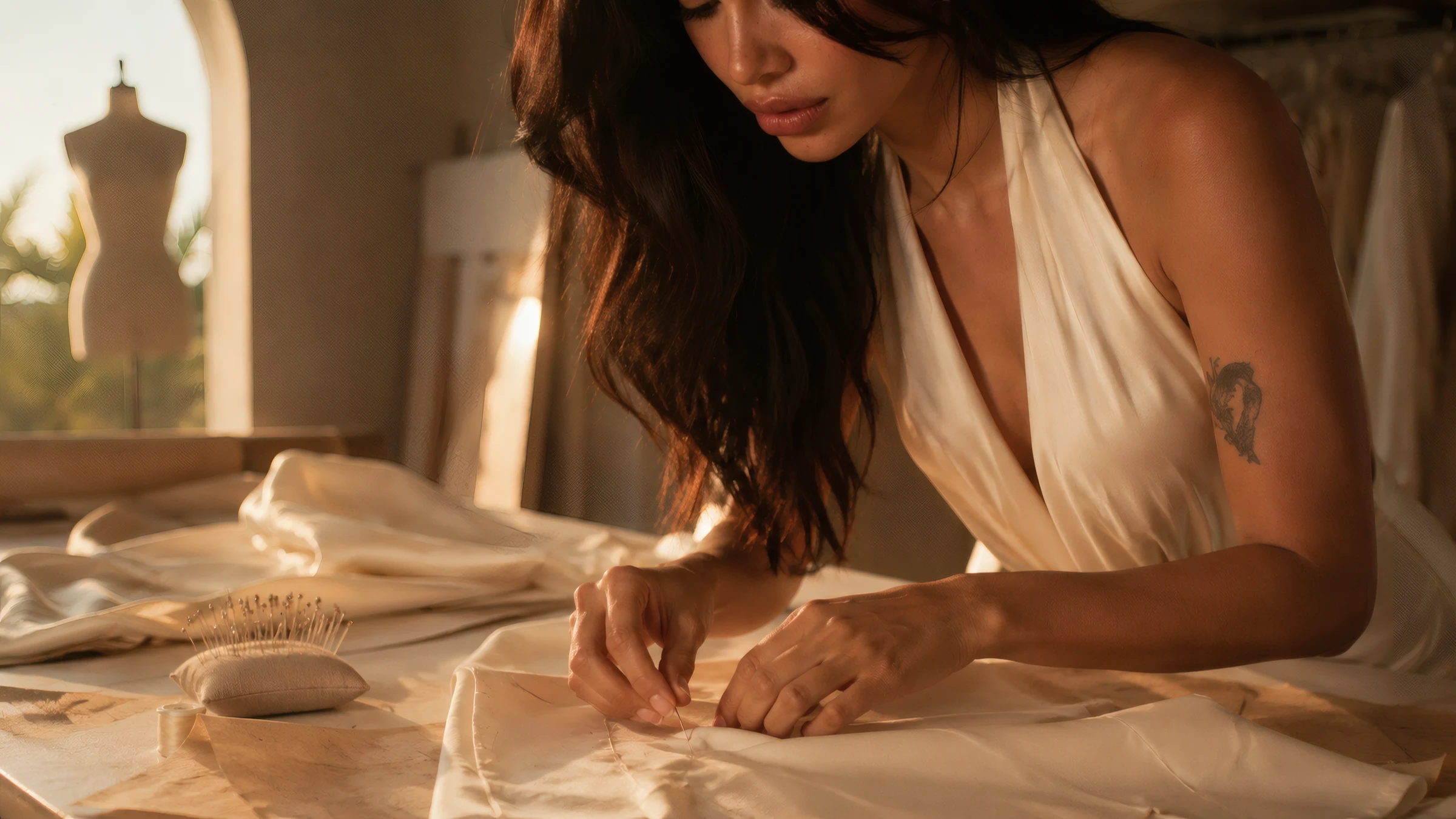
Thai Silk & FabricHow to Care for Silk So It Outlives YouSilk is generous if you treat it as a living fibre, not laundry. The atelier's protocol for washing, drying, ironing, storing and rescuing a silk garment.June 2026·6 min read
PatternmakingThe Block: The Mother Pattern Behind Every GarmentNo collection begins with a design. It begins with a block — the styleless foundation pattern from which every dress, shirt and trouser is born. Meet the maison's quiet origin.June 2026·6 min read
Style & WardrobeThe Poetry of Understatement: Why Less Holds MoreUnderstatement is not the absence of expression but its discipline. On negative space, the held note, and the quiet confidence of dressing with restraint.June 2026·6 min read
Haute CoutureAnatomy of an Evening Gown: What Holds the Magic UpA layer-by-layer dissection of a couture evening gown — the inner corselette, the boning and waist-stay, the underlining and the bias drape that make a dress hold itself.May 2026·7 min read
Thai Silk & FabricIs Silk Sustainable? An Honest ReckoningSilk is natural, biodegradable and long-lived — but the question deserves a fuller answer. Water, the moth, peace silk and why longevity is the real metric.May 2026·7 min read
Design & ColourThe Freedom of the Fixed Frame: Why Restraint Makes a Designer BetterA limited palette, a handful of fabrics, a refusal to chase the trend. Why working within strict constraints produces more original design, not less.May 2026·7 min read
The MaisonThe YAYA Woman: A Portrait Drawn in RestraintShe is not an age or an income bracket. The YAYA woman is a sensibility — a way of choosing, of carrying herself, of valuing the few over the many.May 2026·6 min read
Tailoring & FitThe Long Arithmetic: Why a Good Cut Outlives Its DecadeA well-cut jacket is not an expense but a calculation that improves with time. On cost-per-wear, the patina of fine cloth, and why true luxury is measured in decades, not seasons.May 2026·7 min read
Slow FashionAgainst the Calendar: What Slow Fashion Really MeansSlow fashion is not a trend but a refusal — to rush the making, to chase the season, to treat clothes as disposable. A clear definition, and why it matters.May 2026·6 min read
PatternmakingDrafting the Column: A Sheath Dress, Line by LineThe column dress looks like the simplest gown in the wardrobe. On the drafting table it is the most exacting. A step-by-step look at how the maison draws one.May 2026·8 min read
Style & WardrobeThe Economics of the Timeless Piece: Cost Per Wear and the Long ViewWhy the expensive coat is often the cheapest. A clear-eyed look at cost per wear, the false economy of trends, and how to invest in pieces that outlast the decade.May 2026·7 min read
The AtelierThe Silence of Handwork: On the Quiet That Couture RequiresWhy the finest hand-finishing happens in near-silence, what that quiet does to the work, and how the patience of the needle becomes part of the garment itself.May 2026·6 min read
Design & ColourThe Detail That Decides Everything: On the Things You Almost Cannot SeeA hidden seam, a hand-rolled hem, the exact set of a collar — the small, often invisible details that separate a fine garment from an ordinary one.May 2026·6 min read
Haute CoutureWhy Couture Still Matters in the Age of the AlgorithmIn a world of fast fashion and AI-generated style, why haute couture endures — as the last keeper of hand-knowledge, a brake on speed, and a quiet argument for slowness.May 2026·7 min read
The MaisonWhy We Began: A House Founded as a Quiet ArgumentMaison YAYA was not founded to fill a gap in the market. It was founded to make a quiet argument against how the luxury industry had come to work.May 2026·6 min read
Thai Silk & FabricWild and Cultivated: Two Philosophies of SilkCultivated silk is bred for perfection; wild silk is gathered from the forest with all its character intact. A study of tussar, the two textures and what each gives a garment.May 2026·6 min read
Slow FashionThe Ethics of Luxury: Can Beauty Be Made Without Harm?Luxury once meant excess. We argue it should mean responsibility — that true rarity today is a beautiful thing made well, fairly, and without hidden cost.May 2026·8 min read
Style & WardrobeThe Uniform You Choose: On Wearing the Same Thing BeautifullyThe personal uniform is not a failure of imagination but its highest form. Why the most stylish women repeat themselves — and how to find the formula that becomes you.April 2026·6 min read
PatternmakingThe Science of Grading: How One Pattern Becomes Many SizesA single perfect pattern must become a whole range of sizes without losing its proportions. Grading — the precise, invisible craft of scaling a garment to many bodies.April 2026·7 min read
Tailoring & FitThe Hidden Skeleton: A Field Guide to Interfacings and StructureBeneath every collar, cuff and lapel lives an unseen skeleton of canvas, horsehair and felt. A guide to the structures that hold a garment's shape — and the hand that builds them.April 2026·7 min read
The AtelierFrom Sketch to First Toile: Where a Drawing Learns to Stand UpThe journey from a pencil croquis to the first calico toile — how a flat idea is translated into three dimensions, and why the first version is meant to be wrong.April 2026·7 min read
Design & ColourLight as a Material: How a Coastline Becomes a CollectionThe light of the Andaman coast, the lines of Thai architecture, the colours of the shoreline — how a designer reads the natural world and translates it into cloth.April 2026·7 min read
Garment CarePacking the Suitcase: How to Travel With Delicate ClothesAn atelier guide to travelling with silk, cashmere and tailoring — the folding methods that defeat wrinkles, what to roll, what to hang, and the rescue kit for arrival.April 2026·6 min read
Haute CoutureBy the Light of a Needle: Hand Embroidery and PassementerieAn atelier guide to couture embellishment — tambour beading, the Lunéville hook, goldwork and passementerie, and why a hand-embroidered panel takes a hundred hours.April 2026·7 min read
The MaisonThe Promise Behind the Label: What Maison YAYA GuaranteesA maison's name is a promise. Here is exactly what Maison YAYA promises — about how a garment is made, what it will cost you, and how long it will last.April 2026·7 min read
Slow FashionBuilt to Be Inherited: The Anatomy of a Garment That LastsWhat separates a dress your daughter could wear from one that fails by winter? A look inside the construction that lets a garment outlive a trend.April 2026·7 min read
Style & WardrobeDressing for a Wedding by the Sea: The Destination Guest's ManualHeat, sand, salt air and three days of celebration. How to pack for a destination wedding with grace — fabrics that travel, a palette that flatters, and the art of being a guest.April 2026·8 min read
PatternmakingThe Margin That Holds Everything: On Seam AllowanceThe strip of cloth beyond the stitching line is the most overlooked part of a pattern — and the one that decides whether a garment can be built, finished, and let out.April 2026·6 min read
Thai Silk & FabricThe Hand Knows: Telling Real Silk From Its ImitationsPolyester has learned to shimmer. Here are the senses and small tests that still separate true silk from its clever imitations, used in the atelier daily.April 2026·6 min read
Tailoring & FitThe Three Conversations: Inside the Fittings That Make a Garment YoursA bespoke garment is not measured once and made. It is built through a series of fittings — the baste, the forward, the finish — each a conversation between cloth, tailor and body.April 2026·7 min read
The AtelierThe Light of the Workroom: Couture's Most Underrated ToolHow natural northern light, the raking dusk and the honesty of shade shape every decision in the atelier — from colour matching to the final fitting.April 2026·6 min read
Garment CareThe Atelier Drawer: The Essential Garment-Care KitThe small, considered collection of tools that lets you care for fine clothes at home — from the right soap to a cashmere comb, and what to leave on the shelf.April 2026·5 min read
Design & ColourHow a Collection Is Born: From a Single Image to a Finished WardrobeA collection does not begin with a dress. It begins with a feeling, an image, a single thread of an idea. Inside the long, quiet process of how a collection takes shape.April 2026·8 min read
Haute CoutureThe Ghost Before the Gown: On the ToileWhy every couture garment begins as a toile — a calico ghost of the final dress — and how the fitting process turns a flat pattern into a piece made for one body.March 2026·6 min read
The MaisonFrom an Island to the World: Why a Luxury House Begins in PhuketLuxury is assumed to come from Paris or Milan. Maison YAYA comes from a Thai island — and that is not a disadvantage to overcome but the whole point.March 2026·6 min read
Slow FashionFrom Field to Rail: Why a Maison Should Name Its MakersTransparency is not a marketing word but a discipline. A look at the full chain behind a single garment — and why we believe a buyer deserves to know it.March 2026·7 min read
PatternmakingThe Art of Moulage: Designing With Cloth, Not PaperSome shapes can only be found by hand. Inside moulage — the couture practice of draping fabric directly on the form to discover a garment as it is born.March 2026·7 min read
Style & WardrobeThe Restraint of Fewer Things: A Philosophy of AccessorisingThe art of accessorising is the art of subtraction. How to choose one true object over many — the single earring, the considered bag, the watch worn for years.March 2026·6 min read
The AtelierWhy Phuket: The Unlikely Home of a Quiet Couture HouseNot Paris, not Milan — Phuket. The story of why Maison YAYA chose an island for its atelier, and what the place gives the cloth that a capital never could.March 2026·6 min read
Garment CareThe Long Wear: How to Make a Garment Last a LifetimeThe philosophy and practice of making clothes last — washing less, repairing early, rotating wisely, and the small habits that turn a purchase into an heirloom.March 2026·7 min read
Tailoring & FitCut for Her: How Tailoring Learned to Speak the Female BodyMenswear tailoring shrunk down is not womenswear. A study of darts, the bust, the waist-to-hip curve and the suppression that lets a jacket follow a woman without confining her.March 2026·8 min read
Design & ColourThe Mathematics of Grace: Proportion as the Hidden RuleWhy some outfits look effortlessly right and others faintly wrong. A study of proportion — hemlines, waistlines, the rule of thirds — the quiet law beneath elegance.March 2026·7 min read
Thai Silk & FabricMomme: The One Number That Tells the Truth About SilkThread count belongs to cotton. Silk has momme — the single measure that reveals weight, durability and how a fabric will fall. Here is how to read it.March 2026·6 min read
Haute CoutureTwo Hands, Two Worlds: The Flou and the TailleurInside the atelier flou and atelier tailleur — the two distinct workrooms of couture, why a chiffon hand cannot cut a jacket, and what each kind of skill teaches.March 2026·6 min read
Style & WardrobeReading the Neutrals: How to Find the Palette That Loves Your SkinNot every ivory flatters. A guide to the warm and cool undertones of the perfect neutral palette — camel, greige, bone, oatmeal — and how to find yours in daylight.March 2026·7 min read
The MaisonDressing the Woman Who Leads with GraceAuthority no longer needs armour. How Maison YAYA dresses the woman who leads — without the borrowed severity of the boardroom uniform she was once handed.March 2026·7 min read
Slow FashionThe True Price of Cheap: What a Five-Dollar Dress Actually CostsSomeone always pays for fast fashion's low price — a river, a worker, a season's landfill. An unsparing look at the bill that never reaches the buyer.March 2026·7 min read
PatternmakingFrom Flat to Form: The Journey of Cloth Onto the BodyHow does a flat sheet of silk become a living silhouette? The geometry of turning two dimensions into three — and why ease, not measurement, is the secret.March 2026·7 min read
Garment CareThe Dry Cleaner's Threshold: When to Send a Garment OutA clear-eyed guide to when dry cleaning is truly necessary — which garments need it, which it quietly harms, and how to choose a cleaner worthy of fine clothes.March 2026·6 min read
The AtelierThe Ritual of the First Cut: Why We Slow Down Before the ShearsCutting cloth is irreversible, so the atelier treats it as ceremony — truing the grain, resting the bias, reading the light before a single thread is severed.March 2026·6 min read
Tailoring & FitThe Invisible Plumb Line: Why Balance Is the Soul of TailoringBalance is the quality you feel before you can name it — the reason a jacket hangs serene and still. A study of front and back balance, and how tailors find a garment's equilibrium.March 2026·7 min read
Garment CareOn Cashmere: How to Keep a Sweater for a DecadeA complete guide to cashmere and wool care — why you should wash rather than dry-clean, how to defeat pilling, and the cold rest that doubles a sweater's life.February 2026·7 min read
Design & ColourWhen Texture Becomes the Subject: Designing for the Hand and the EyeIn a palette stripped of colour, texture carries the whole emotion of a garment. How surface — matte, liquid, brushed, slubbed — becomes the protagonist of a design.February 2026·7 min read
Haute CoutureWhat Makes a Garment Couture: Reading the InsideWhat actually makes a garment couture — hand-felled seams, an inner architecture of canvas and horsehair, and the tells you can find by turning a piece inside out.February 2026·6 min read
Thai Silk & FabricMudmee: The Thai Art of Dyeing a Pattern Before It Is WovenIn Thai ikat, the design is dyed into the thread before a single line is woven. A reading of mudmee — its blurred edges, its mathematics, its soul.February 2026·7 min read
Slow FashionThe Art of Mending: To Repair Is to BelongA torn hem is not the end of a garment but a chapter in it. On the quiet dignity of repair — and the techniques that keep a beloved piece in the world.February 2026·6 min read
The MaisonL'Aurore: The Name of First LightL'Aurore means the dawn — the hour before the world insists on anything. What the name means to Maison YAYA, and why a collection is named for first light.February 2026·6 min read
The AtelierTools of the Trade: The Instruments of a Couture AtelierTailor's shears, the ham, the point presser, the thread that disappears — a guided tour of the humble, exacting tools behind every couture garment.February 2026·7 min read
PatternmakingThe Quiet Power of the Dart: How a Fold Becomes a ShapeA dart is nothing more than a folded-out wedge of cloth, yet it is how flat fabric learns the body. Understanding the small fold that gives a garment its form.February 2026·6 min read
Style & WardrobeFrom Noon to Midnight: The Many Lives of a Slip DressThe bias slip is the wardrobe's most fluent piece — how to wear one to a luncheon, an office and a candlelit dinner without ever changing the dress beneath.February 2026·6 min read
Tailoring & FitWhere the Jacket Ends: On the Quiet Tyranny of the ShoulderThe shoulder is the one thing a tailor cannot easily fix and the first thing a trained eye reads. How a shoulder should sit, what divots and ridges reveal, and why fit lives here.February 2026·6 min read
Garment CareSteam, Never Scorch: The Gentle Way to Release a WrinkleHow to remove wrinkles from delicate fabrics without damaging them — when to steam, when to iron, and the bathroom trick that saves a silk dress before dinner.February 2026·5 min read
Design & ColourSilhouette: The First Decision a Garment Ever MakesBefore fabric, before colour, before a single seam — there is the line a garment cuts against the air. A study of silhouette and why it carries a whole design.February 2026·6 min read
The AtelierThe Hands Behind the Cloth: A Couture Garment Has Many AuthorsEvery Maison YAYA piece passes through several pairs of hands — the cutter, the tailor, the finisher, the embroiderer. Meet the makers and the marks they leave.February 2026·6 min read
Haute CoutureThe Englishman Who Invented Haute CoutureThe history of haute couture, from Charles Frederick Worth signing his gowns to the legal birth of the term — and why a 19th-century idea still rules fashion.February 2026·7 min read
The MaisonThe Grammar of Quiet: What Silent Luxury Actually MeansQuiet luxury is not an aesthetic of beige. It is a discipline — of restraint, proportion and honesty. The philosophy that governs every Maison YAYA decision.February 2026·7 min read
PatternmakingAgainst the Grain: How the Bias Cut Transforms a DressCut a length of silk at forty-five degrees and it learns to flow. The story of the bias cut — Vionnet's revolution and why it still defines the maison's slip gowns.February 2026·7 min read
Thai Silk & FabricThree Moths, Three Silks: Mulberry, Eri and MugaNot all silk is one fibre. A field guide to mulberry, eri and muga — three moths, three temperaments, and how each behaves on the body.February 2026·7 min read
Slow FashionWhat the Loom Remembers: The True Footprint of SilkSilk is beautiful, but it is not weightless. An honest account of its footprint — from mulberry leaf to dye vat — and how a maison chooses to weigh less.February 2026·7 min read
Style & WardrobeThe Grammar of Quiet Luxury: Dressing Below the LogoQuiet luxury is not a trend but a literacy — the cut, the cloth, the finish that speak only to those who can read them. A field guide to dressing below the logo.February 2026·6 min read
Tailoring & FitCanvas or Glue: The Quiet Decision Inside Every JacketFull canvas, half canvas or fused — the single construction choice that decides whether a jacket moulds to you over years or bubbles and dies. How to tell which you are buying.February 2026·7 min read
Garment CareThe Art of the Empty Wardrobe: How to Store Fine ClothesHow to store luxury clothing so it survives the years — the right hangers, why you should never use plastic, and the difference between a closet and an archive.January 2026·7 min read
Thai Silk & FabricThe Colours of Isan: Natural Dyeing of Thai SilkIndigo, ebony pods, lac and mango leaf — how the dye gardens of northeast Thailand colour silk by hand, and why the result outlives any synthetic.January 2026·7 min read
Thai Silk & FabricThe Architecture of Silk: A Guide to Thai Mulberry and Raw SilkHow to identify, choose and care for authentic Thai silk — mulberry vs. raw silk, the weight and hand of true Bombyx mori, and why the maison cuts from royal-grade Thai cloth.January 2026·8 min read
Design & ColourThe Quiet Architecture of Colour: Building a Wardrobe Within One FamilyHow a luxury house designs an entire collection from ivory to camel — the colour theory behind a neutral palette, and why restraint reads as richness.January 2026·7 min read
The AtelierA Day in the Atelier: From First Light to the Last StitchInside a working day at the Maison YAYA atelier in Phuket — the rhythm of couture from dawn cutting to dusk handwork, told hour by hour.January 2026·7 min read
Garment CareThe Quiet Bath: How to Wash Silk at Home Without FearA step-by-step atelier method for hand-washing silk at home — water temperature, the right soap, and how to dry a slip gown so it returns to you unmarked.January 2026·6 min read
Haute CoutureCouture and Prêt-à-Porter: The Line Most People Cannot SeeWhat truly separates haute couture from prêt-à-porter — fit to one body versus a size chart, hours of hand-work, and the philosophy beneath both.January 2026·6 min read
The MaisonThe Woman Who Began with a Needle: How Maison YAYA Was FoundedBefore there was a maison there was Yaya, a Thai designer, a borrowed table and a single bolt of silk. The founding story of Maison YAYA, told plainly.January 2026·6 min read
PatternmakingThe Blueprint of a Garment: What Patternmaking Really IsBefore a dress exists, it lives as paper. An introduction to patternmaking — the quiet architecture that turns a body and an idea into cloth that moves.January 2026·6 min read
Slow FashionFewer, Better Things: A Quiet Argument for the Considered WardrobeWhy buying less and buying better is the most luxurious decision a woman can make — the maison's case for a wardrobe built slowly, on purpose.January 2026·6 min read
Style & WardrobeThe Capsule of Twelve: Building a Wardrobe That Thinks for YouA method for the capsule wardrobe — twelve pieces that multiply into a season. How to choose anchors, the rule of the third outfit, and what to leave on the rail.January 2026·7 min read
Tailoring & FitThe Anatomy of a Blazer: Reading a Jacket From the Inside OutA guided tour through the hidden architecture of a well-cut blazer — collar, gorge, lapel roll and back vent — and what each part tells you about the hand that made it.January 2026·7 min read