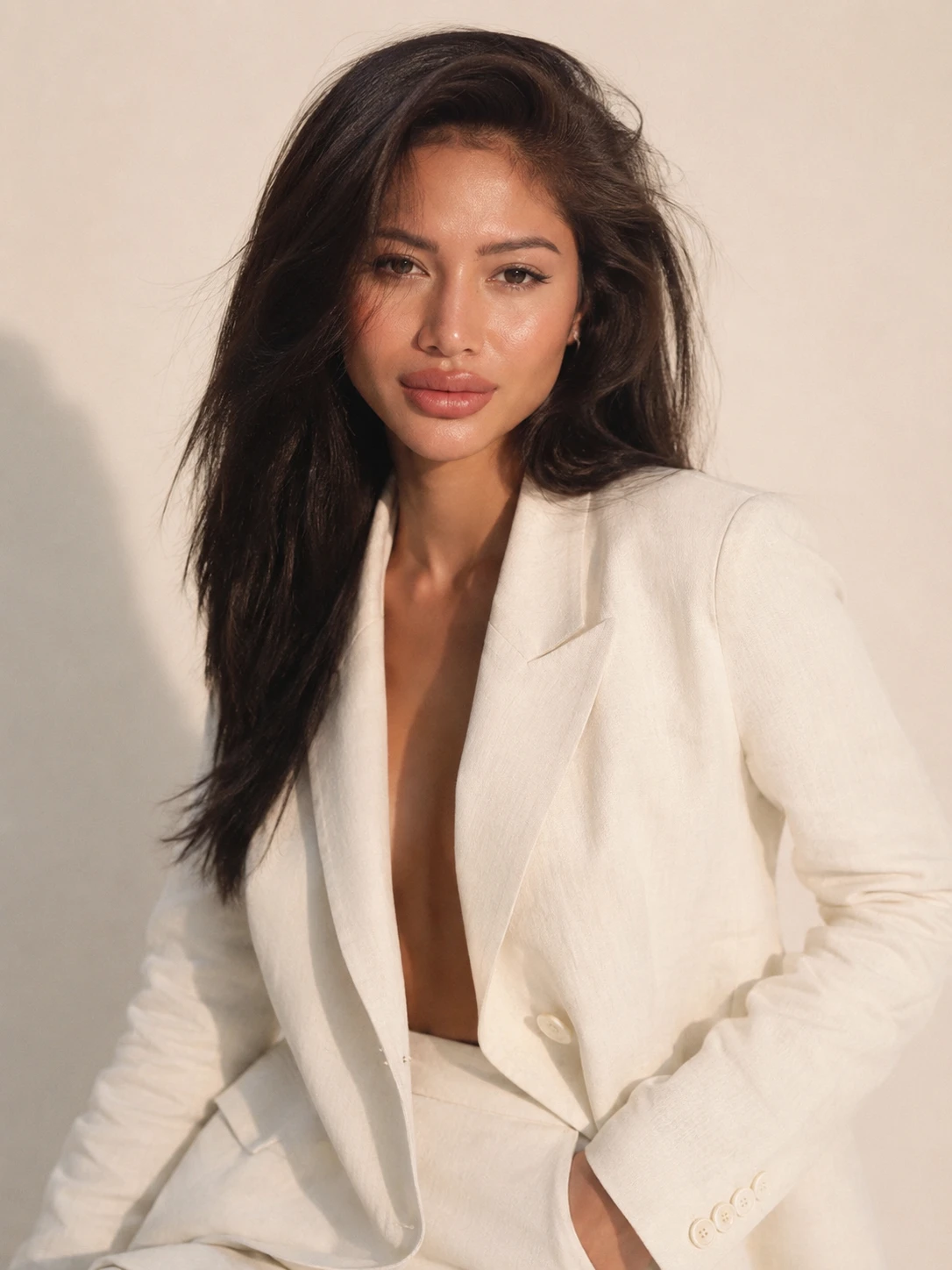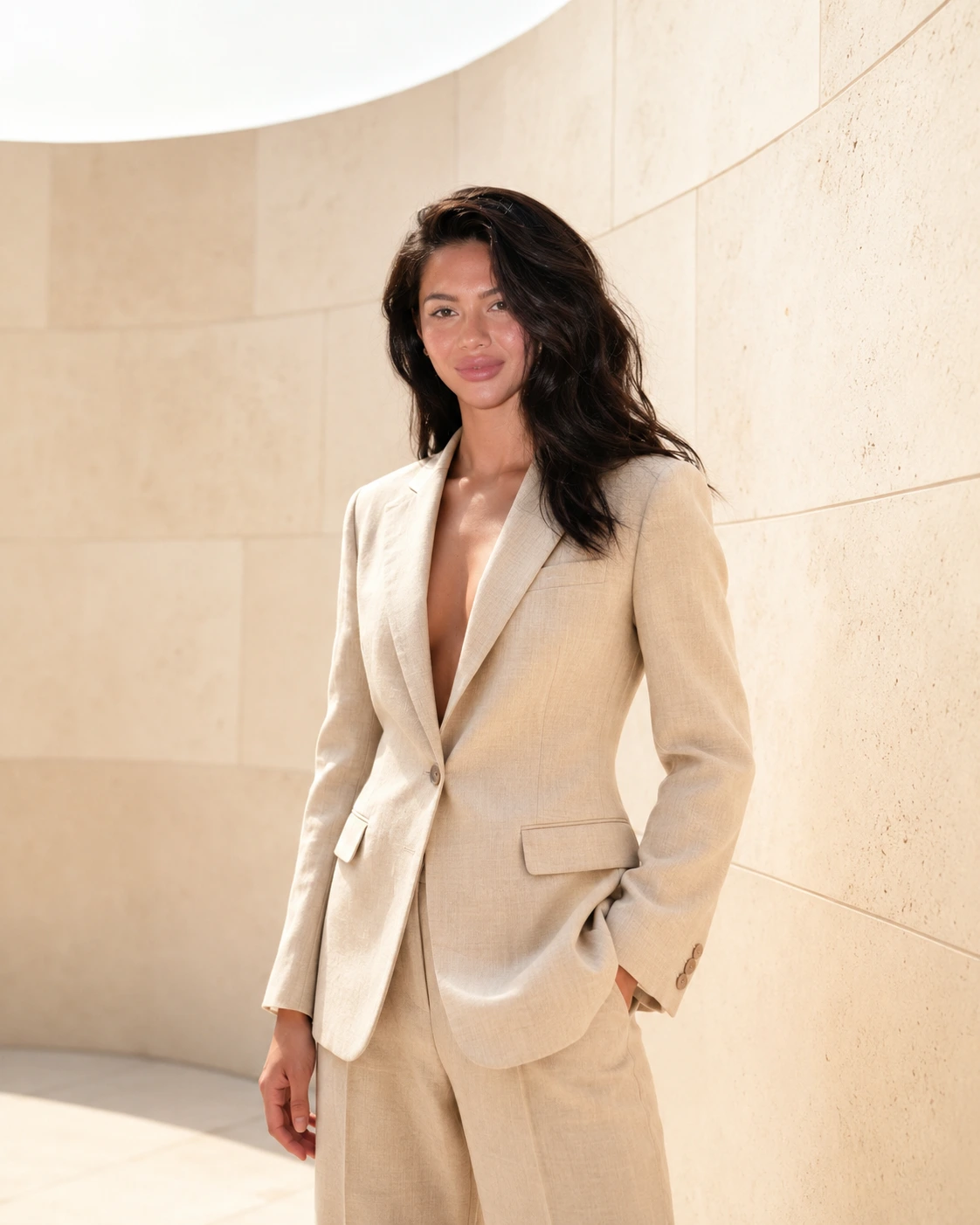
Menswear tailoring shrunk down is not womenswear. A study of darts, the bust, the waist-to-hip curve and the suppression that lets a jacket follow a woman without confining her.
For most of its history, tailoring was a language spoken about men. When women's tailoring arrived, the lazy answer was simply to take a man's jacket and make it smaller. The result is a garment that fits no one — too straight through the body, too flat across the chest, too rigid through the curve from waist to hip. Real womenswear tailoring is not menswear shrunk down. It is a different grammar, built around a different body.
The problem of the curve
A man's torso, broadly, runs in fairly straight lines from shoulder to hip. A woman's does not. The female form moves through a series of curves — the fullness of the bust, the inward draw of the waist, the outward sweep to the hip — and cloth, which wants to hang in flat planes, has to be persuaded to follow them. The tools of that persuasion are darts and seams, and how a tailor places them is the whole art.
Darts: the cloth's small surrenders
A dart is a folded, stitched wedge of cloth that removes excess fabric so a flat plane can curve into a three-dimensional shape. On a woman's jacket the most important is the bust dart, which gives the cloth room to pass over the fullest part of the chest and then draw back in beneath it. Without it, a jacket either gapes at the bust or strains across it — the familiar pulling at the button that tells you a garment was never cut for a woman's chest.
“A man's jacket hides the body. A woman's jacket should agree with it — follow the curve without ever gripping it.”
Yaya, Founder & Creative Director
Suppression, and the art of the waist
Tailors call the shaping of cloth into the waist suppression — the amount of fabric quietly removed through the side seams and back darts to draw the jacket in. Too little, and the jacket reads as a box; the waist disappears and the figure with it. Too much, and the cloth strains, pulls horizontal lines across the front, and confines rather than flatters. The right suppression follows the waist closely while leaving a hand's worth of ease, so the jacket traces the figure without imprisoning it.
The things a female jacket must answer for
When we cut for the female form at the maison, a handful of relationships have to be solved together, never in isolation:
- The bust-to-waist drop — how sharply the cloth draws in below the chest, which differs enormously between women of the same dress size.
- The waist-to-hip sweep — giving the jacket enough room over the hip so it does not flare or pull when you sit.
- The shoulder-to-bust balance — keeping the front from riding up or pulling open across a fuller chest.
- The armhole — cut higher and cleaner than menswear convention, so the arm can move without dragging the whole front of the jacket with it.
- Length — a hem that ends in proportion to the leg and the waist, not at the widest point of the hip.
Ease: room to be a person
The finest compliment a tailored jacket can earn is that it looks fitted and feels free. That paradox lives in ease — the small, deliberate margins of room built in at the bust, the waist and the back so the wearer can breathe, reach, embrace and sit without the cloth protesting. A jacket with no ease photographs beautifully on a mannequin and becomes unbearable on a woman by lunchtime. Tailoring for a real body means tailoring for a body that lives.
The quiet confidence of a jacket that fits
There is a particular ease a woman carries when her jacket is genuinely cut for her — when nothing pulls at the bust, nothing gapes at the waist, nothing rides up when she reaches across a table. She stops adjusting herself. She forgets she is wearing it. That forgetting is the goal of everything we do: a garment so honestly cut to the female form that it disappears into the woman wearing it, and leaves only her.