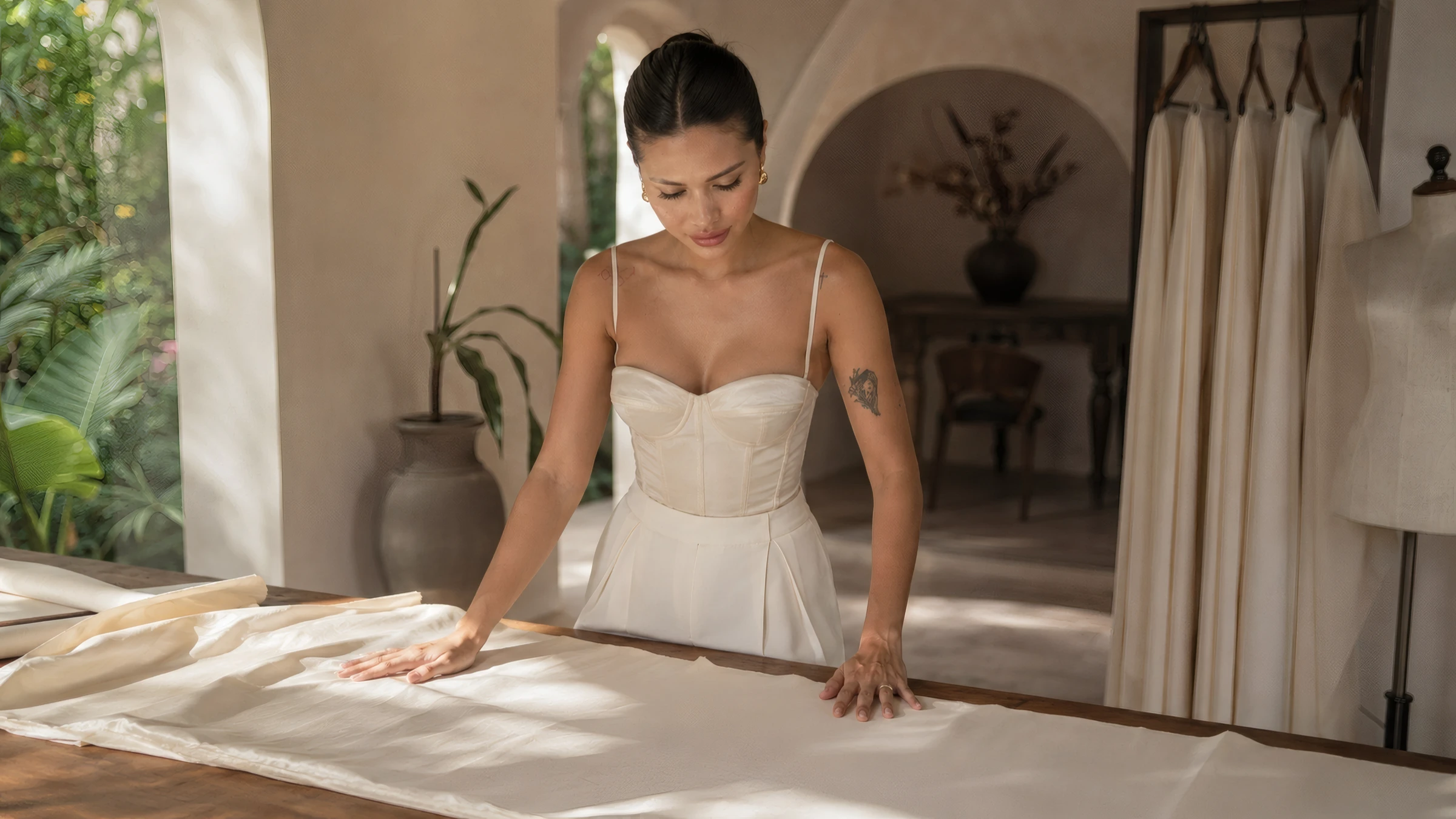
She is not an age or an income bracket. The YAYA woman is a sensibility — a way of choosing, of carrying herself, of valuing the few over the many.
Every house imagines a woman it is making clothes for, and most houses describe her in the language of marketing — an age, a salary, a city, a set of aspirations to be sold back to her. The maison imagines someone too, but she resists that kind of description. The YAYA woman is not a demographic. She is a sensibility, and she can be found at any age, in any city, in any season of a life. What she shares with the others is not a number. It is a way of choosing.
She has stopped trying to be seen
There is a moment in some women's lives — and it does not arrive at the same time for everyone — when the need to be looked at quietly falls away. It is not resignation; it is arrival. She no longer dresses to provoke a reaction, to signal status, or to be read across a room. She dresses because she has somewhere to be and someone to be there as. This is the threshold of the YAYA woman. The clothing that suited the earlier hunger no longer fits the present self, and she begins to want something quieter, more exact, more hers.
“I am not designing for a woman who wants to be noticed. I am designing for the one who has stopped checking whether she has been.”
Yaya, Founder & Creative Director
How she chooses
You can know this woman less by what she owns than by how she decides. Her relationship to acquisition is unusual in a culture built on excess, and it shows in a few consistent habits.
- She buys rarely and keeps long, preferring one considered piece to a closet of compromises.
- She trusts her hand — she has learned the feel of good cloth and is no longer persuaded by a label alone.
- She values the maker, and finds the story of how a thing was made more compelling than the story of who else wears it.
- She dresses for herself first, and treats being well-dressed for others as a pleasant consequence rather than the goal.
What she is not
It would be easy to make her sound austere, a woman of self-denial in beige. She is not. She loves beautiful things — perhaps more than the woman who buys constantly, because she buys so seldom that each choice carries real weight. She is not minimal out of principle but out of pleasure; she has simply discovered that a small number of excellent things gives her more than a large number of adequate ones ever did. Her restraint is not a sacrifice she endures. It is a luxury she has learned to afford herself.
Why a house needs to know her
A maison that does not know precisely who it dresses ends up dressing no one in particular, and clothes made for no one in particular have a way of feeling like it. Knowing the YAYA woman keeps the house honest. It tells us when a detail is for her and when it is merely for show; when a garment serves her life and when it serves only the photograph. She is the question we ask of every piece before it leaves the atelier — not whether it is impressive, but whether it is hers.
So this is the woman the maison was built around: composed without being cold, discerning without being severe, drawn to the few good things and unmoved by the many adequate ones. She does not need our clothes to tell anyone who she is. She already knows. We simply make the garments that let her go on being it, quietly and at ease, for as many years as good cloth can last.