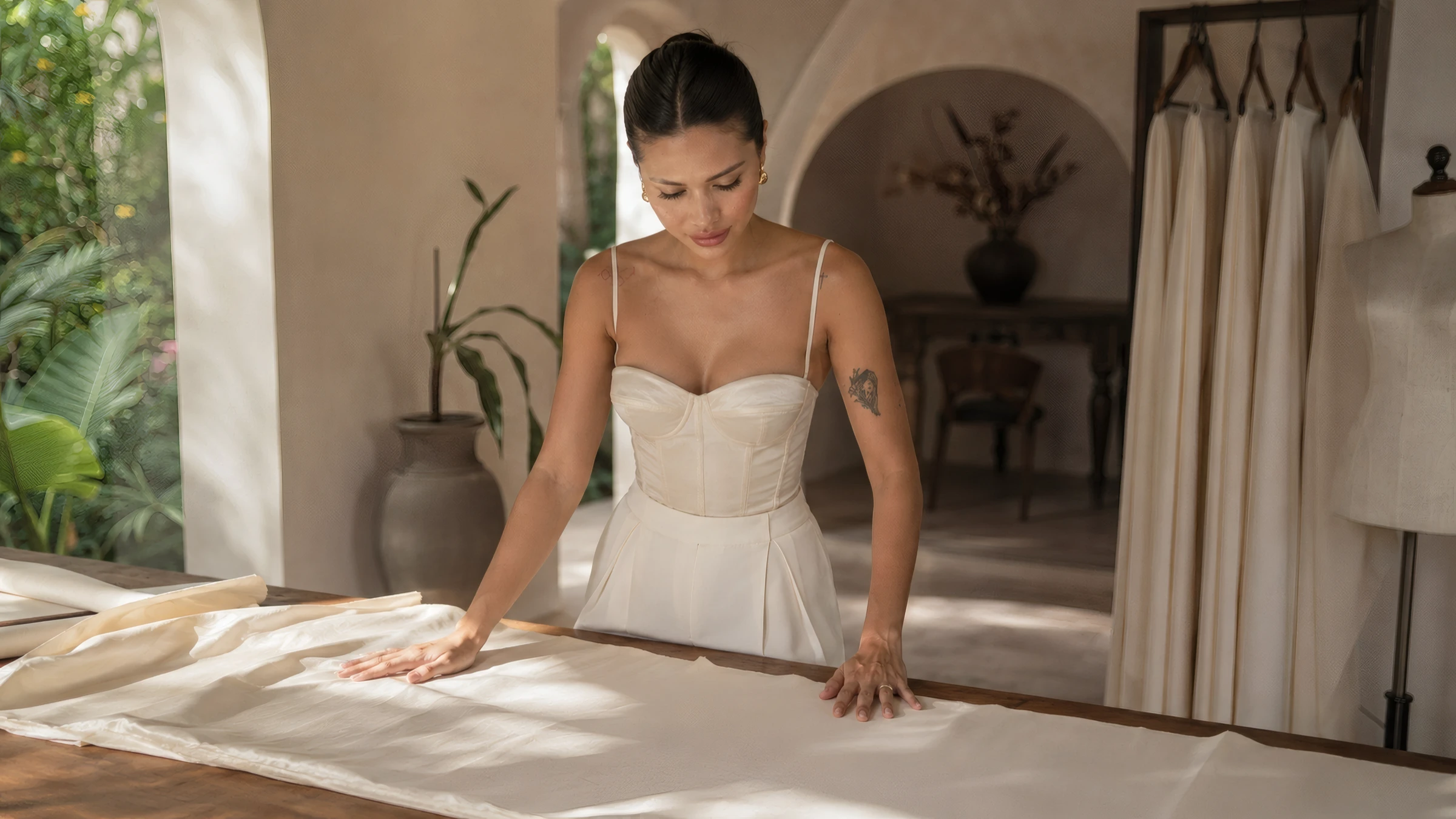
A maison's name is a promise. Here is exactly what Maison YAYA promises — about how a garment is made, what it will cost you, and how long it will last.
A label sewn into the back of a garment is a small thing, easily ignored. It is also a signature. When a house puts its name to a piece, it is making a promise — that the thing is what it appears to be, that it was made the way the house claims, and that it will behave over years the way the house implies. Most labels make that promise vaguely and hope no one checks. We would rather say plainly what ours means, so that you can hold us to it.
We promise the garment is what it says it is
This sounds like a low bar. In the luxury industry it is not. A great deal of expensive clothing is finished by machine while being sold as handwork, blended with synthetics while being described as pure, and manufactured in haste while being marketed as craft. Our first promise is the most basic and the most often broken: that when we tell you a hem is finished by hand, it is; that when we say a cloth is Thai mulberry silk, it is; and that the price you pay reflects the making rather than the myth.
“I do not want you to trust me. I want to tell you enough that you do not have to — so that what I claim can simply be checked against what you hold.”
Yaya, Founder & Creative Director
The four things behind our name
If a promise cannot be stated specifically, it is not a promise — it is a mood. Here, without softening, is what the maison's label stands behind.
- Material honesty — natural fibres named truthfully, sourced close to where they grow, never disguised by finishing tricks.
- Genuine handwork — the hems, the critical seams and the finish are done by human hands, and we will tell you which.
- Fair making — the people who make our clothes are paid fairly and treated as named craftspeople, not hidden links in a chain.
- Built to be kept — construction sound enough that the garment is meant to outlast its first decade, not its first season.
What we will not promise
A promise is only credible if it has edges — if there are things the house refuses to claim. We will not promise that our clothes are without any environmental cost; no one who makes physical things honestly can. We will not promise newness for its own sake, because we do not believe in replacing things that still serve. And we will not promise that you need many of our garments. We would rather sell you few things you keep than many you discard. A house that promises everything is promising nothing you can rely on.
Why the promise has to be small to be true
Large houses make large promises because scale forces them to. When you produce hundreds of thousands of units, the promise becomes abstract — it cannot be tied to any particular hand or any specific cloth. The maison stays deliberately small precisely so that its promise can remain literal. Yaya knows the makers. She has handled the cloth. The chain between the claim and the garment is short enough that nothing can hide inside it. Smallness is not a limitation we apologise for. It is what makes the promise keepable.
So this is the promise behind the label, stated plainly enough to be used against us if we ever fail it: that the garment is honest, that the hands were real, that the people were paid, and that the thing was built to be kept. We would rather you knew exactly what we stand behind than admired a label that quietly stood behind nothing. The name is small. The promise it carries is not.