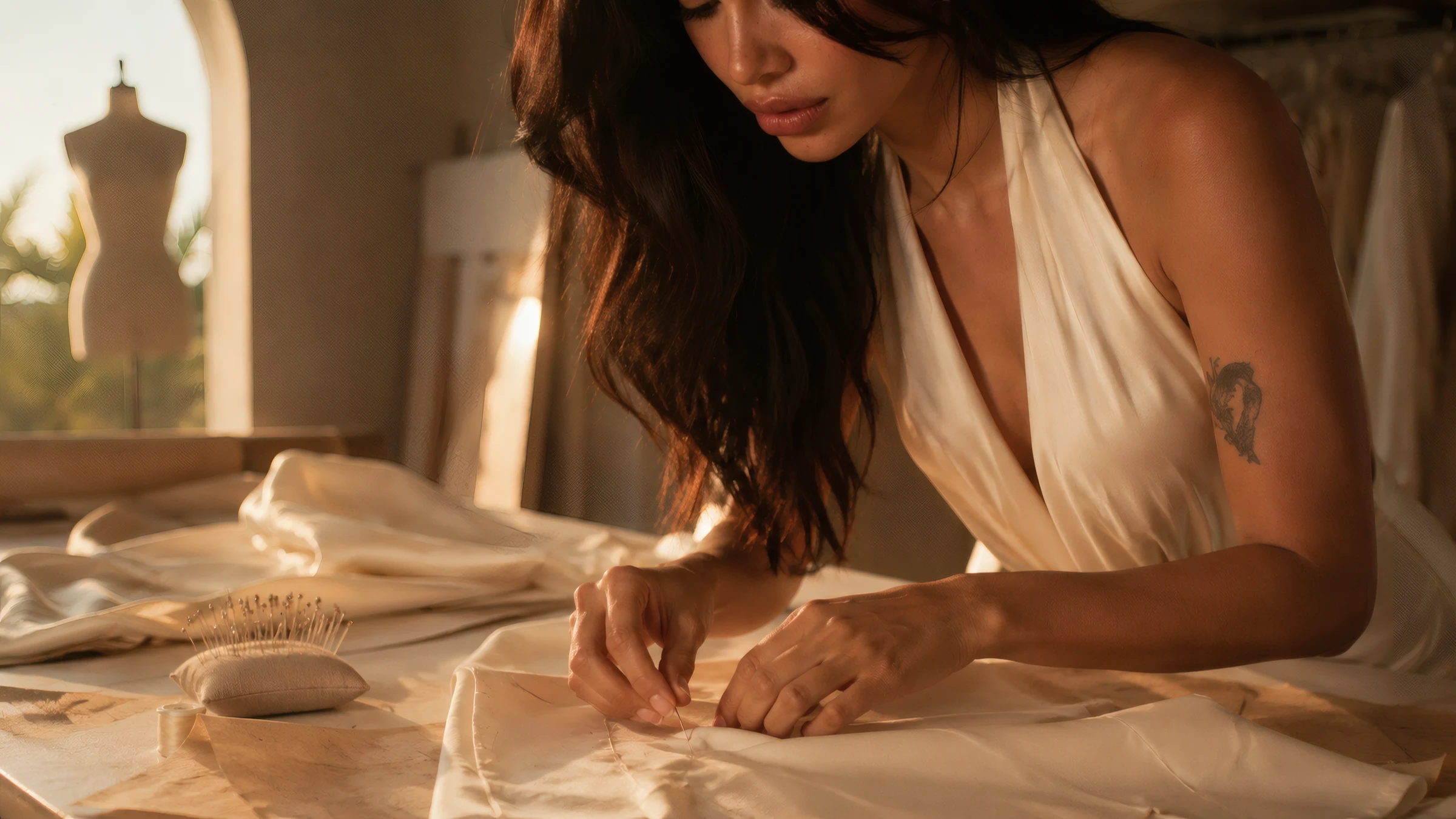
In a world of fast fashion and AI-generated style, why haute couture endures — as the last keeper of hand-knowledge, a brake on speed, and a quiet argument for slowness.
It is a fair question, and we should not flinch from it: in a world where a dress can be designed by an algorithm, manufactured in a fortnight, and worn once for a photograph, why does haute couture still exist? It is slow, it is costly, it rarely turns a profit, and almost no one can buy it. By every metric of the present age it should be extinct. And yet it endures — not in spite of being everything the moment is not, but precisely because of it.
The last library of the hand
The most important thing couture preserves is not dresses but knowledge — the kind that lives only in trained hands and cannot be written down. How to pad-stitch a lapel so it rolls forever. How to read the moment a bias seam is about to twist. How to set a sleeve so the arm moves without the shoulder lifting. This is the savoir-faire of generations, passed from one pair of hands to the next over years of apprenticeship. If the ateliers close, the knowledge does not move to a hard drive. It simply ends. Couture is, in the truest sense, a living library — and every collection keeps the lamps lit for one more season.
A deliberate brake on speed
Fast fashion has trained a whole culture to expect the new every week, the disposable, the immediate. Couture is the opposite proposition held up as a mirror: a single garment that took a year of skill to make possible and is built to last a lifetime. It argues, without raising its voice, that some things should be slow — that a dress can be an heirloom rather than a feed item, kept and altered and handed down rather than discarded. In an economy of speed, slowness itself becomes the radical luxury.
- It preserves hand-knowledge that exists nowhere but in trained artisans and would otherwise be lost.
- It is the research laboratory where techniques are perfected before reaching ready-to-wear.
- It defends the idea of permanence against a culture of disposability.
- It keeps a fair, skilled wage attached to craft, rather than to speed and volume.
- It proves, season after season, that clothing can still be made for a person rather than a market.
The laboratory upstream
There is a practical answer too, often missed. Couture is the laboratory where ideas are perfected before they ever reach the rest of us. A cut, a construction, a finishing technique is invented and refined at the couture level — where time and cost are no object — and then, simplified and adapted, it flows downstream into ready-to-wear and eventually into ordinary clothing. Much of what makes any well-made garment well-made was first solved in an atelier. Kill the laboratory and the whole supply of new ideas slowly runs dry.
“We live in an age that confuses fast with good. Couture is the quiet correction — the reminder that the things worth keeping were never made in a hurry.”
Yaya, Founder & Creative Director
What a small house owes the great craft
Maison YAYA is not a couture house, and we are clear-eyed about that. But couture is the reason we exist as we do. Its discipline tells us to cut on grain, to finish the inside, to build a toile before the silk, to pay our weavers in Surin for time rather than rush them for volume. Every value we hold was first proven, over a century and a half, in the ateliers of Paris. To love quiet luxury and to ignore couture would be a contradiction. We carry the craft forward at a scale a woman can actually live in — which is, in its own small way, how a great tradition stays alive.
So the question turns over. It is not whether couture can survive the age of the algorithm. It is whether the age of the algorithm can afford to lose the one place that still remembers how to make things slowly, and by hand, and well.