An atelier guide to couture embellishment — tambour beading, the Lunéville hook, goldwork and passementerie, and why a hand-embroidered panel takes a hundred hours.
Hold a hand-embroidered panel to a window and you will see the work breathe — sequins catching light at a hundred slightly different angles, beads casting tiny shadows, gold thread refusing to lie flat the way machine-laid thread always does. Embroidery is where couture stops being clothing and becomes something closer to jewellery worked into cloth. And almost none of the techniques that matter most are done with an ordinary needle. They are done, astonishingly, with a hook, from the wrong side of the fabric.
The hook that works backwards
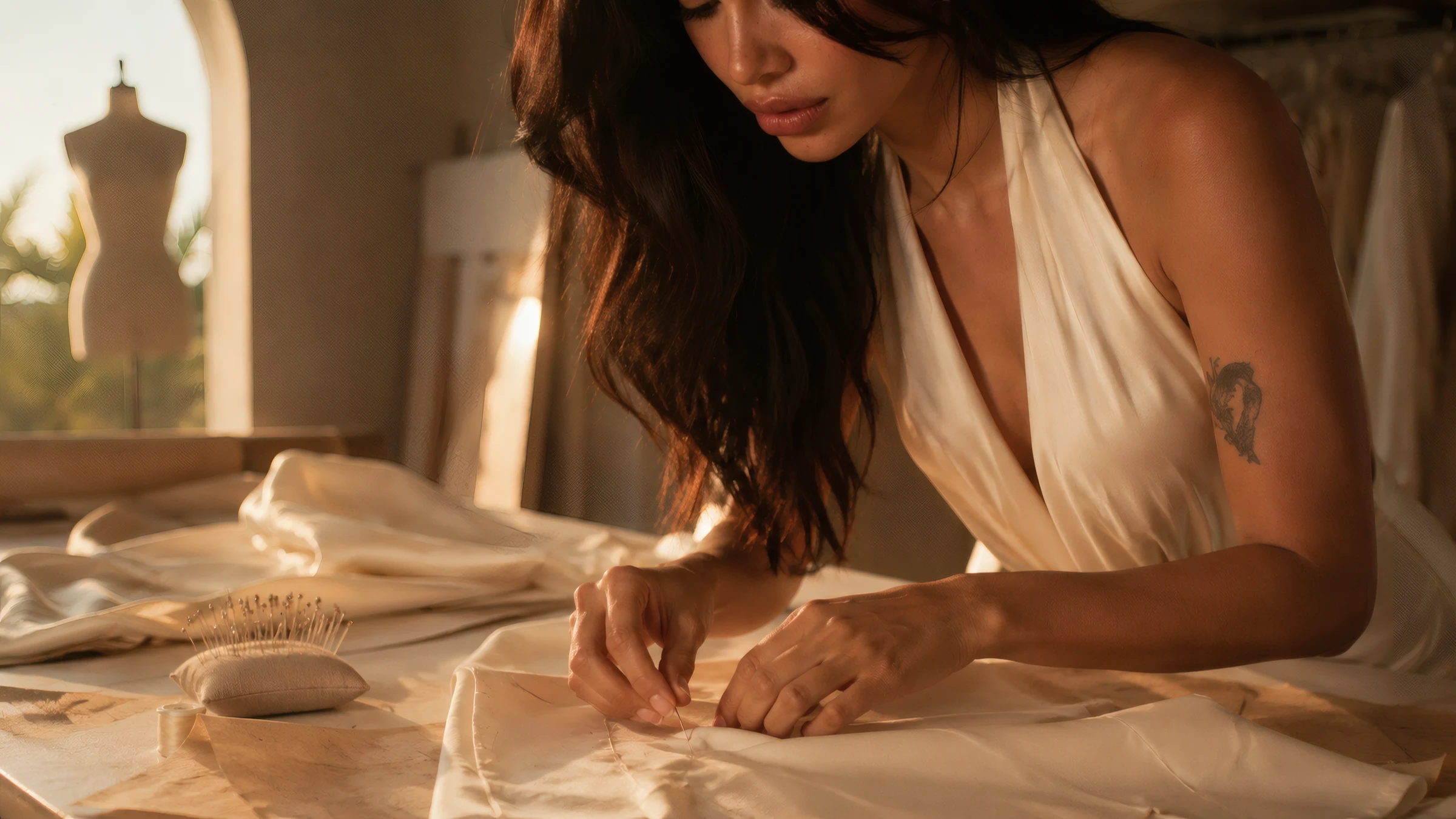
The signature technique of couture embroidery is tambour work, named for the drum-tight frame on which the fabric is stretched. The embroiderer holds a fine hook — the crochet de Lunéville, perfected in that French town in the 1800s — above the cloth, while her other hand feeds thread, beads and sequins from below. The hook pierces the fabric, catches the thread, and pulls up a chain stitch that locks each bead in place. She works the design in reverse, reading it as a mirror, never seeing the right side until she turns the frame. A skilled tambour beader can be ten times faster than someone sewing beads one by one with a needle — and the result is stronger, every bead anchored in a continuous chain.
The vocabulary of embellishment
Embroidery is not one craft but a library of them, and a great atelier commands the whole shelf. Each technique carries its own light, its own weight, its own century of refinement.
- Tambour beading — beads and sequins laid in a chain stitch with the Lunéville hook, the backbone of couture sparkle.
- Goldwork — metal threads couched to the surface with silk, the ancient technique of ceremonial and ecclesiastical dress.
- Soutache and passementerie — decorative braids, cords and trims shaped and sewn into scrolling patterns on the surface.
- Appliqué — shapes of one fabric, often lace or organza, sewn onto another and edged by hand.
- Stumpwork and raised embroidery — padded forms that lift off the cloth in low relief, catching shadow as well as light.
Passementerie: the architecture of trim
Passementerie is the old French art of trimmings — braids, tassels, cords, fringes and frogging, made on their own small looms and by hand. It is a craft most people never name, yet they recognise it instantly: the frogged closures of a military-inspired jacket, the silk cord edging a lapel, the deep bullion fringe on a hem. Where embroidery decorates the field of the cloth, passementerie defines its edges and openings. A single passementier may spend a career mastering one family of knots. The frogging on a fine jacket is not bought by the metre; it is built, loop by deliberate loop, by a hand that has tied that knot ten thousand times.
“Embroidery is patience made visible. Every bead is a small decision, and a panel holds tens of thousands of them — each one chosen, not scattered.”
Yaya, Founder & Creative Director
Why the hours are the point
A heavily embroidered couture panel can absorb a hundred hours of a single artisan's life, sometimes far more. That number is not a problem to be solved by machines; it is the value itself. Machine embroidery lays every stitch at the same tension and the same angle, and the eye reads that uniformity as flat, as printed. Hand embroidery carries the tiny, irreducible variation of a living hand, and that variation is exactly what makes it shimmer. You are not paying for sparkle. You are paying for the hundred hours, and for the eye that decided where each fraction of light should fall.
At Maison YAYA we use embellishment sparingly and only by hand — a quietly beaded shoulder, a passementerie closure, a hand-couched detail at a cuff — in keeping with the restraint of silent luxury. When we add it, we add it because a single hundred-hour panel can carry a whole gown. The rest of the dress simply makes room for the light.