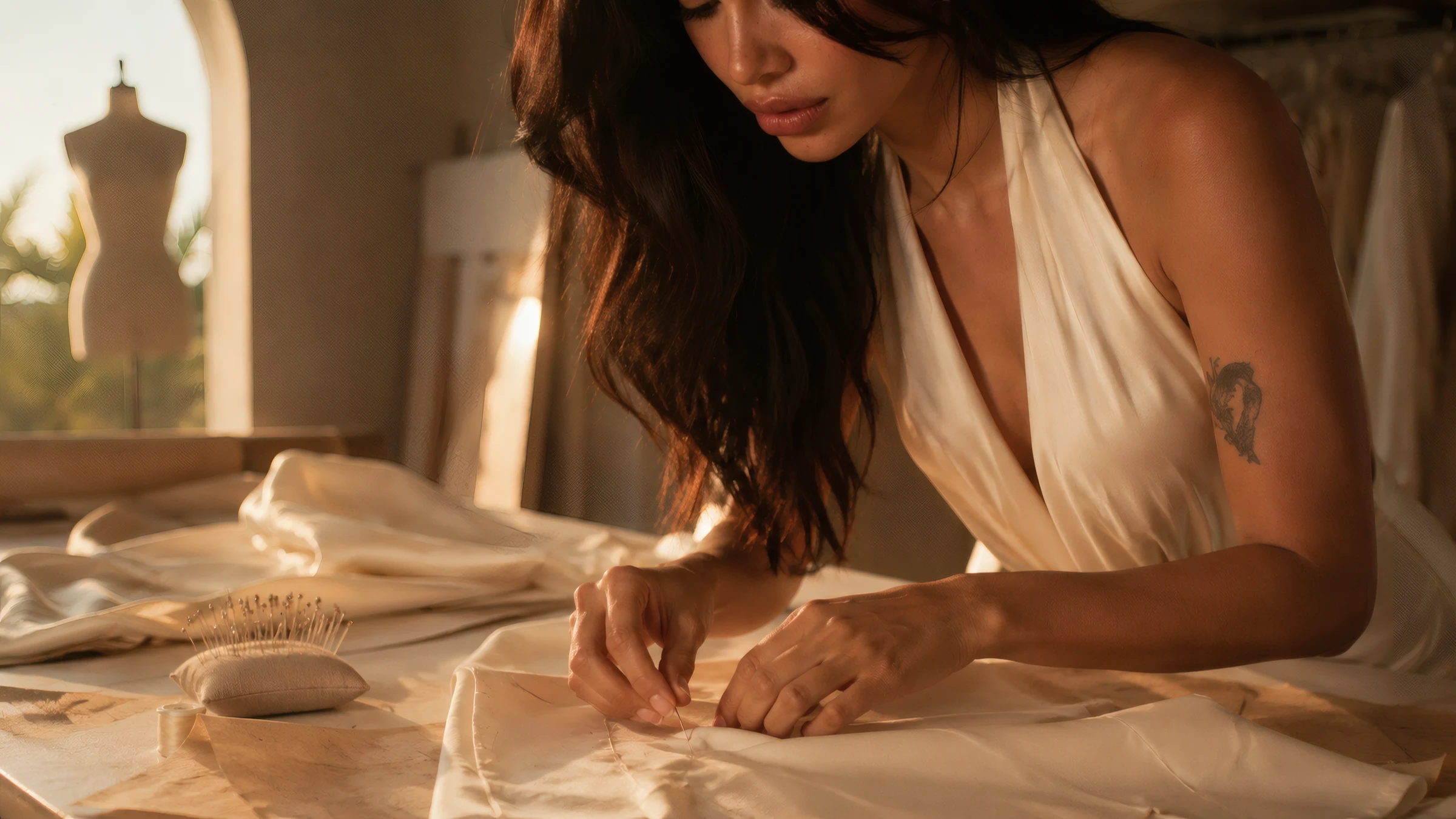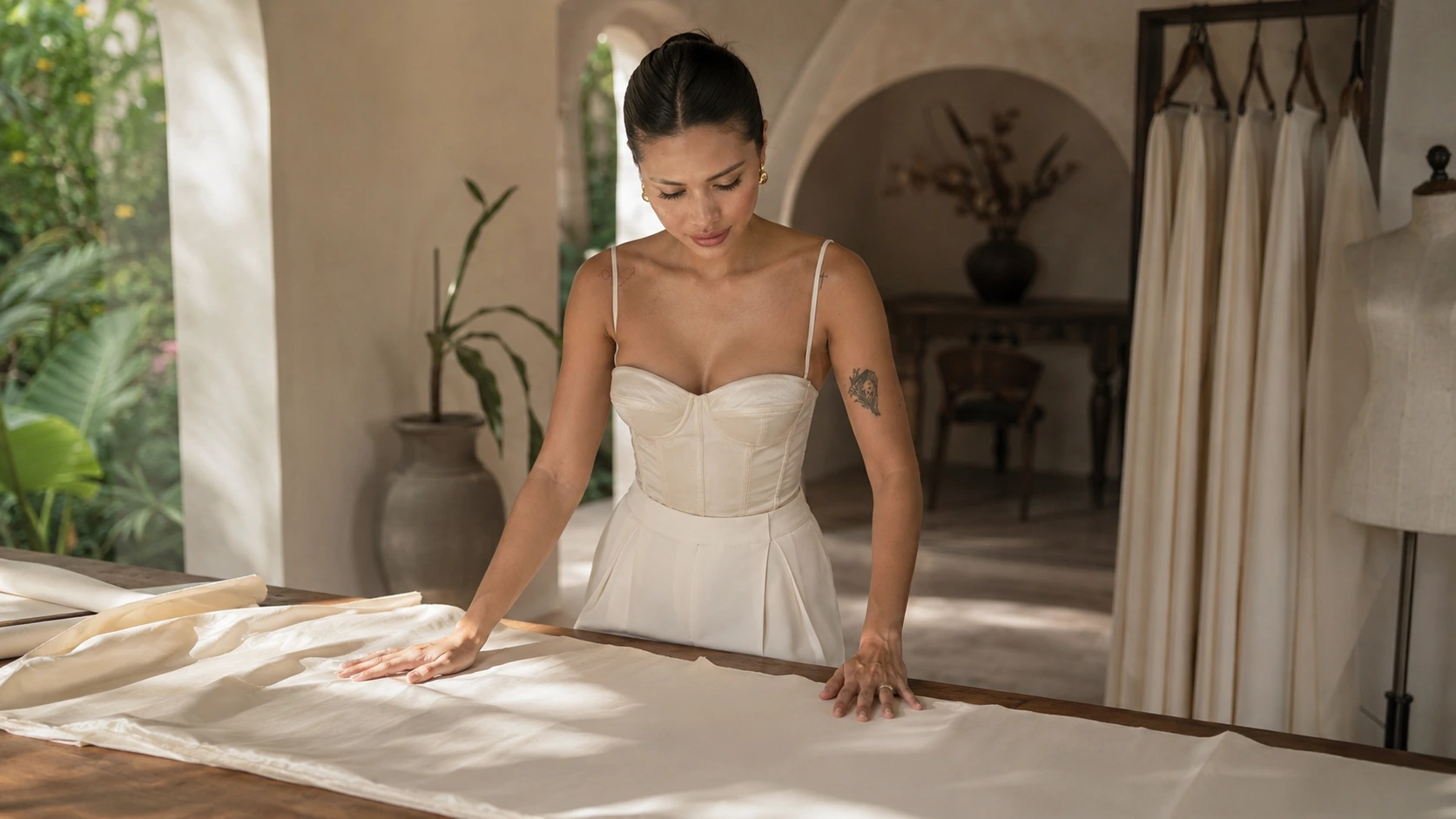
The column dress looks like the simplest gown in the wardrobe. On the drafting table it is the most exacting. A step-by-step look at how the maison draws one.
Of all the silhouettes the maison makes, the column dress is the one that hides the least. There is no flounce to forgive an error, no gather to disguise a wandering line. A long, lean sheath that skims the body from shoulder to hem succeeds or fails entirely on the truth of its pattern. To draft one well is to understand patternmaking in miniature — every principle, with nowhere to hide.
Where every column begins
The draft starts not from the dress but from the block — the maison's perfected bodice-and-skirt foundation, fitted on the form until it sits without a single wrinkle. The block carries no style, only the body: the correct bust, waist and hip, the right back length, the true armhole. Every column dress is a conversation with this block. We do not draw a dress from nothing; we draw the difference between the block and the dress we want.
“The column tells the truth about your patternmaking. A full skirt will lie for you. A sheath never will.”
Yaya, Founder & Creative Director
The draft, step by step
On the table, the column emerges in a deliberate order. Each step depends on the one before:
- Trace the bodice and skirt blocks together, aligning them at the waist, to create one continuous front and one continuous back from shoulder to hem.
- Set the length — the column lives or dies on its hem, so the finished length is decided early and the skirt is extended to it, plus a deep hem allowance.
- Shape the side seam: a clean, slightly curved line from the underarm, drawing in at the waist and easing back out over the hip, so the dress skims rather than clings.
- Place the waist darts — front and back — to suppress the cloth between the fuller bust or hip and the narrower waist, the only shaping a true column allows itself.
- Refine the neckline and armhole to the chosen design, lowering and smoothing the block's conservative curves into the line the dress wants.
- Add a back vent or a discreet slit at the hem, because a narrow column must give the legs somewhere to move, or the wearer cannot walk.
- Walk the seams — measure the front and back side seams against each other to confirm they match exactly before any allowance is added.
- Add seam and hem allowances last, in the maison's fixed widths, so the pattern is ready to cut.
The two decisions that make or break it
Two judgements separate a column that flatters from one that fails. The first is ease over the hip: too little and the dress reads as tight, pulling into horizontal strain lines; too much and it reads as a tube, losing the body entirely. The maison sets just enough wearing ease for the woman to sit and walk, and not a millimetre of slack beyond it. The second is the slit — its height, its placement, its discretion. A column with no slit is a beautiful object the wearer cannot move in; a column with too high a slit forgets the quiet of silent luxury. The right one is invisible at rest and merciful in motion.
From paper to silk
The finished draft is never cut straight into cloth. It is made up first in calico, fitted on the form and then on the body, where the sheath reveals every last truth: a side seam a fraction too straight, a dart pointing a few millimetres off, a hem that needs levelling. Only when the toile is flawless does the pattern earn its silk. The column dress in the maison's collection is cut from a single weight of Thai silk, its darts pressed sharp, its hem weighted to fall clean — the whole of patternmaking, drawn line by line, into one unbroken vertical line of cloth.
Wear it, and you wear the discipline. The column flatters precisely because nothing in it is hidden — only resolved.