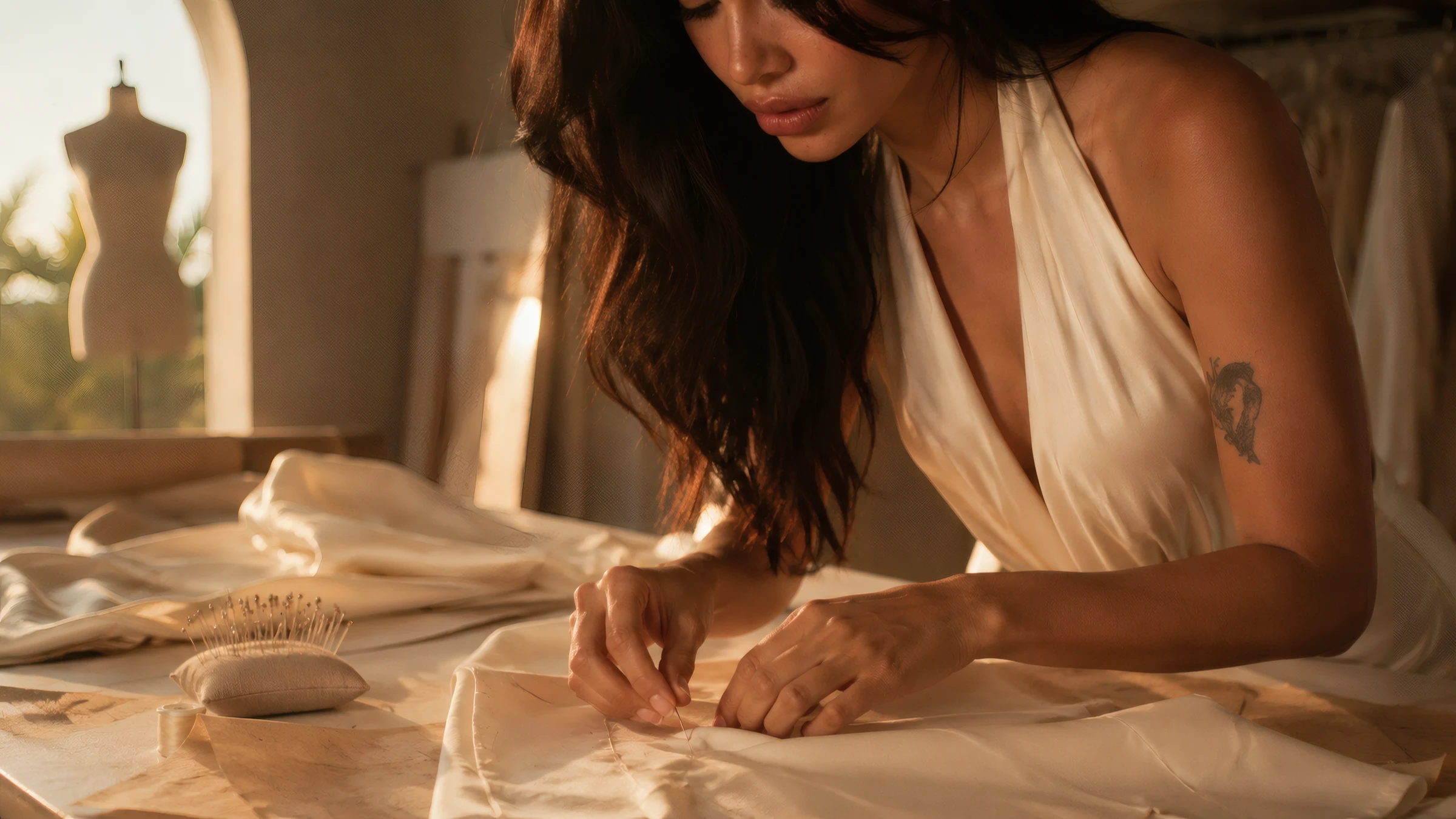
The strip of cloth beyond the stitching line is the most overlooked part of a pattern — and the one that decides whether a garment can be built, finished, and let out.
On every pattern piece there are two lines that matter. One is the seam line — the path the stitching will follow, the true edge of the finished garment. The other runs a little outside it, a quiet parallel: the cutting line. The strip of cloth between them is the seam allowance, and though it will be hidden forever inside the garment, it is one of the most consequential decisions a patternmaker makes.
What the allowance is for
A seam needs fabric to grip. You cannot stitch two pieces together at their very edge — the thread would simply pull through. The allowance gives the seam its purchase, the margin where needle and thread do their work. But it does far more than hold a seam closed. It is also where the seam is finished so it will not fray, where curves are clipped so they can turn smoothly, and where, years later, a garment can be let out or taken in. The allowance is the garment's structural reserve.
“A garment with generous seam allowances is a garment that can grow old gracefully. We cut for the woman she is now, and leave cloth for the woman she will become.”
Yaya, Founder & Creative Director
Why the width is never random
Allowances are not all the same width, and the variation is deliberate. The patternmaker chooses each one for the job that seam must do:
- Side seams of a fine garment are cut generously — often an extra centimetre or more — so the piece can be let out across the bust, waist or hip when a body changes.
- Curved seams, such as a neckline or armhole, take a narrower allowance, because a wide margin on a tight curve bunches and cannot lie flat once turned.
- Hems carry the deepest allowance of all — several centimetres folded up — both to weight the garment so it hangs true and to allow the length to be adjusted.
- Enclosed and graded seams, like a collar or a faced edge, are trimmed to different widths layer by layer so the finished edge stays crisp and thin.
The discipline of consistency
An allowance is only useful if it is honest. If the patternmaker marks a one-centimetre allowance but the sewer takes a centimetre and a half, every measurement downstream is wrong: the garment shrinks, curves no longer match, notches fall out of register. This is why a maison fixes its allowances by convention and holds to them ruthlessly. The cutter knows, the sewer knows, the fitter knows. The margin is a shared agreement, and the whole construction depends on no one breaking it.
Built to be altered
There is a philosophy hidden in how a house treats its allowances. Fast fashion trims them to the bone — barely enough to sew, nothing left to alter — because the garment is not meant to last. The maison does the opposite. Generous, finished, pressed-open allowances are an act of faith in the future of the piece: that it will be loved long enough to need taking in or letting out, passed perhaps to a daughter, altered to a new body. A wide seam allowance is a promise that the garment is not finished — it is merely begun.
So when you turn a YAYA garment inside out and find the seams open, clean and unexpectedly generous, you are looking at the part no one was meant to see — and the part that proves the piece was built to stay with you.