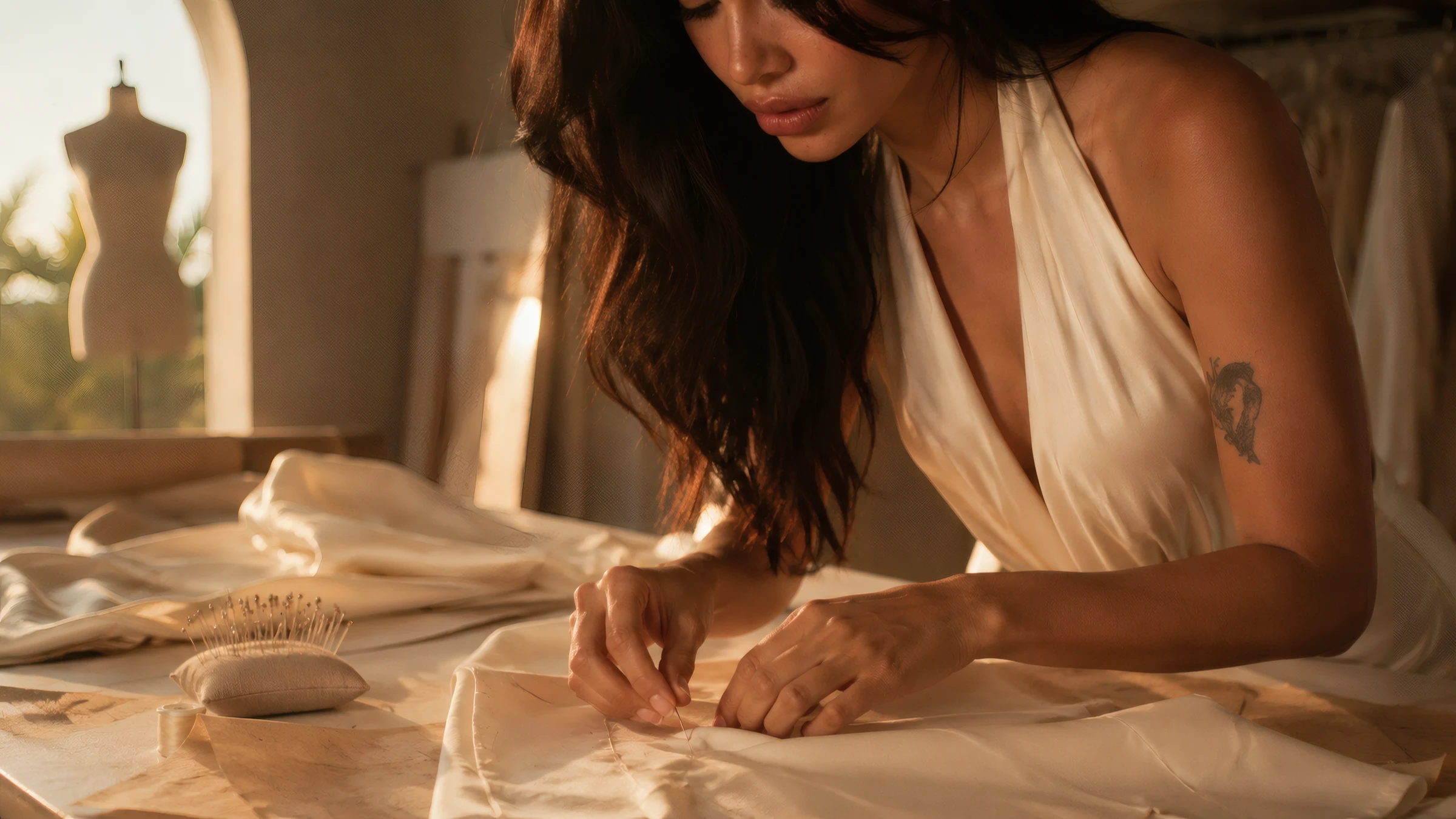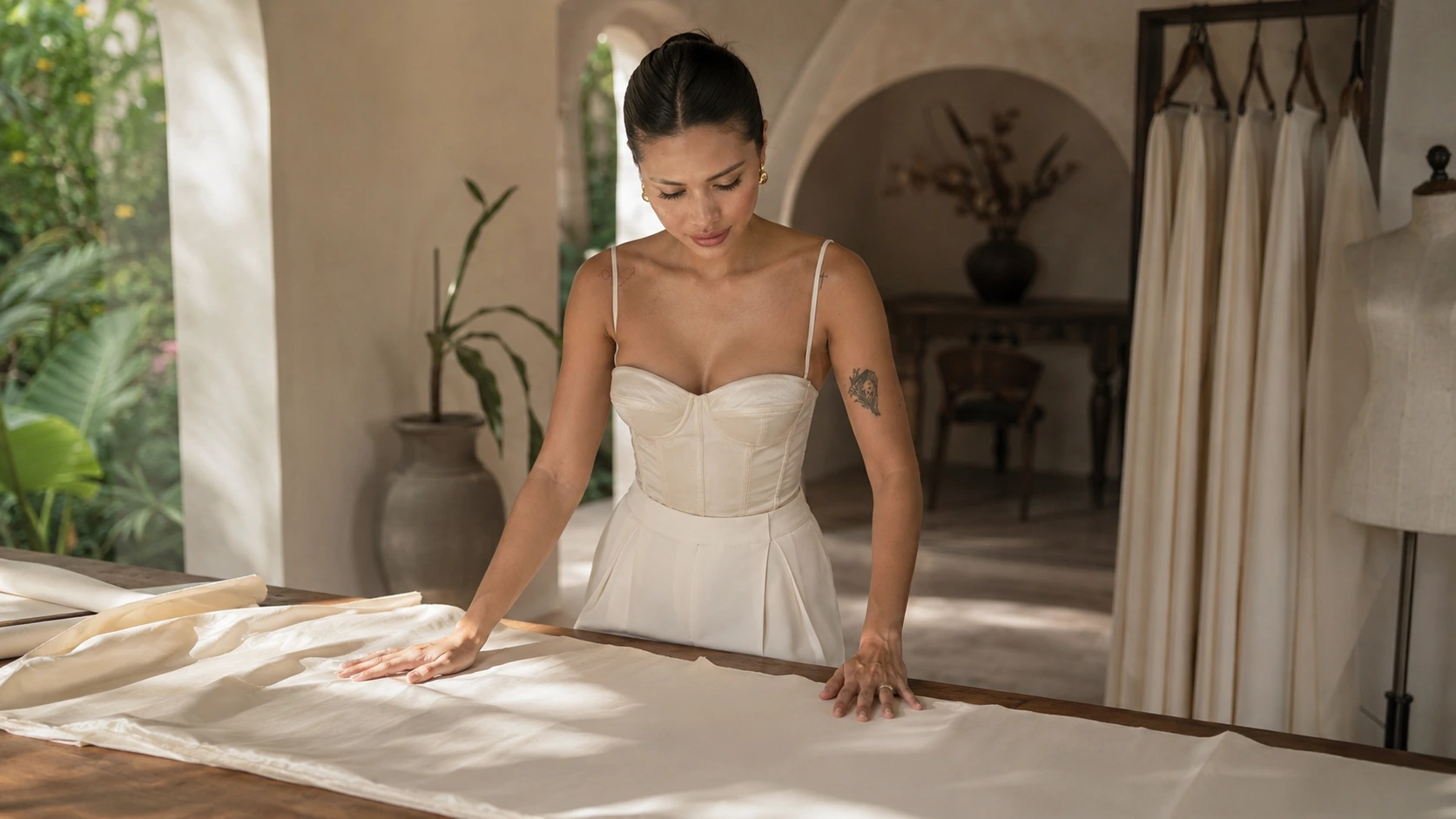
A dart is nothing more than a folded-out wedge of cloth, yet it is how flat fabric learns the body. Understanding the small fold that gives a garment its form.
Hold a sheet of paper flat against a ball and it crumples — it cannot lie smooth over a curve. Now fold a narrow wedge out of the paper and pin the edges together, and suddenly it cups. That fold is the whole idea of the dart, the single most elegant solution patternmaking has ever found to the problem of putting a flat thing around a round body.
What a dart removes
A dart is a tapered fold of fabric stitched out of a flat panel to create three-dimensional shape. It is defined by what it takes away: a wedge, wide at one edge and narrowing to a point, that vanishes into the cloth. Sew that wedge closed and the surrounding fabric is forced into a gentle cone, exactly the cone needed to travel over a bust, a shoulder blade, or the curve from waist to hip. The dart does not add fabric. It subtracts excess so the rest can lie clean.
“A dart should disappear. If you can see where it points, it is in the wrong place. The body should look as though the cloth simply grew that way.”
Yaya, Founder & Creative Director
The grammar of darts
Where a dart sits, and where it points, is a question of both fit and intention. The classic positions each do a particular job:
- The bust dart, pointing toward — but stopping short of — the fullest part of the bust, giving a bodice its room without strain.
- The waist dart, vertical down the front or back, drawing the waist in from a fuller bust or hip and creating the long, clean line of a fitted bodice.
- The shoulder and neck darts, shaping the cloth over the shoulder blade so a jacket sits flat across the upper back.
- The elbow dart, a small fold that lets a fitted sleeve bend without binding — invisible until the arm moves.
Moving a dart without losing its work
Here is the quiet magic the atelier loves: a dart can be moved almost anywhere on a panel without changing the shape it creates, as long as it still points toward the same curve of the body. This is called dart manipulation, and it is how a single bust dart can be rotated into a side seam, hidden inside a princess seam, or released as soft gathers at the neckline. The shaping is identical; only its expression changes. A patternmaker who masters this can hide structure inside style, building the body into a garment that looks entirely uncut.
When we choose a seam instead
In the maison's quietest pieces we often retire the visible dart altogether, absorbing its job into a curved seam — the princess line that runs from shoulder or armhole down through the bust and waist. A seam carries the same shaping as several darts combined, but it reads as a long, deliberate line rather than a stitched fold. It is more work to draft and more cloth to cut, yet the result is a garment with no interruptions across the front: pure silhouette, the shaping dissolved into the design.
The next time a jacket sits cleanly across your back, or a fitted bodice holds its shape through a whole evening without a single wrinkle, look for the darts. You will not find them easily — and that is precisely the point.