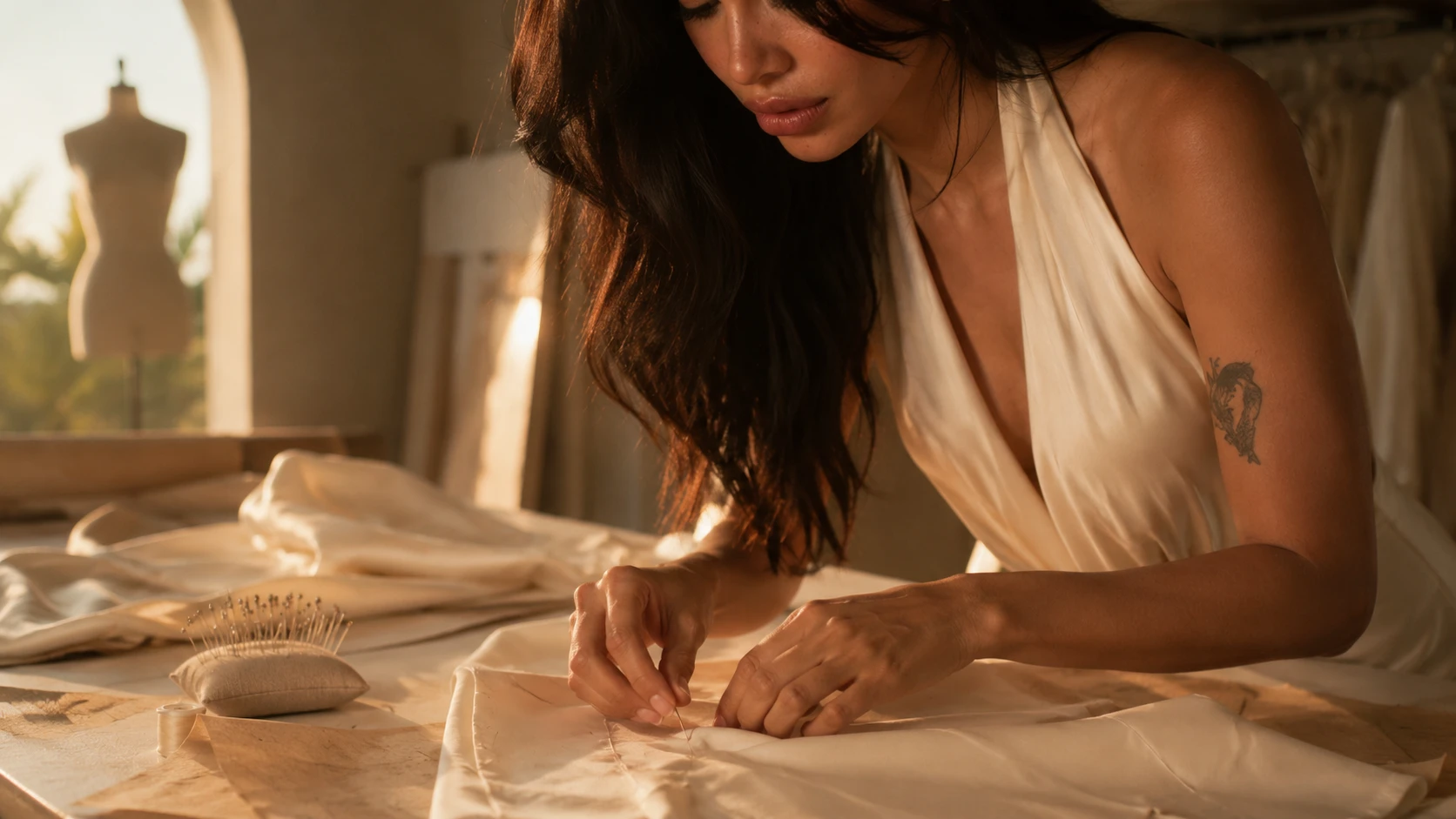
Inside a working day at the Maison YAYA atelier in Phuket — the rhythm of couture from dawn cutting to dusk handwork, told hour by hour.
A couture atelier does not keep office hours. It keeps the hours of the cloth — of glue drying, of bias relaxing, of the moment in late afternoon when the light is finally right for a fitting. This is an ordinary day in our rooms above the old town in Phuket, recorded not because it is unusual but because it is not.
Seven o'clock: the room wakes before the work
The first task of the day belongs to no one's hands. We open the shutters on the east side and let the room breathe. Silk that has rested overnight on the cutting table has settled into the wood; the air, still cool, holds none of the afternoon's humidity that would later make a length of organza cling and lie. We sweep, we wind bobbins, we sharpen. The kettle goes on. For twenty minutes the atelier is only the sound of small preparations, and that silence is part of the craft, not a prelude to it.
Eight to eleven: the cutting hours
Cutting is done early and never rushed, because a length of cloth is cut only once. The morning is given to it for two reasons — the cutter's eye is freshest, and the fabric, before the heat rises, lies flattest. A single bias-cut gown can take three hours to lay, to true the grain, to chalk, and only then to open the shears. We do not stack cutting tasks. One piece, one mind, until the last edge is released.
“I tell every cutter the same thing on their first morning: you are not cutting fabric, you are spending it. There is no more of this exact bolt anywhere in the world.”
Yaya, Founder & Creative Director
The midday pause
Between noon and one the atelier eats together, always, at the long table where toiles are sometimes pinned. It is not sentiment. A maker who has been threading a fine needle for four hours needs to look at the horizon, eat something warm, and let the eyes lengthen their focus. The afternoon work — the close handwork — depends on it.
One to five: the slow hours
The afternoon belongs to the needle. This is when the work that cannot be hurried is done, in the order the cloth demands:
- Hand-rolled hems, which a machine can imitate but never equal — a true rolled hem on silk chiffon is rolled between thumb and finger and caught with a thread you should not be able to see.
- Felling and basting of linings, the invisible architecture that lets a jacket move with the body rather than against it.
- Hand-finished buttonholes, each one worth roughly forty minutes and the reason a couture jacket fastens like a held breath.
- Pad-stitching of collars and lapels, which rolls the canvas so the lapel curves toward the body of its own accord, never to be pressed flat again.
Across these four hours the room speaks very little. There is a particular quality to the quiet of competent hands — unhurried, certain, with the small percussion of a needle pushed through coat canvas marking the time. Visitors often lower their own voices on entering, without being asked.
Five o'clock: the light returns the verdict
Fittings are held at the end of the day on purpose. By five the hard tropical glare has softened to the long, raking, honest light that shows every seam for what it truly is. A hem that read as level at noon may reveal itself half a centimetre proud at dusk. We trust this light above any measurement. A piece that is beautiful in the five o'clock light of Phuket will be beautiful anywhere.
And then the shutters close on the west side, the needles are set down in their cushions point-inward, and the cloth is laid to rest under cotton until morning. Nothing is left half-cut. Nothing is hurried to finish before dark. The work will be here tomorrow, and so, with luck and discipline, will the light.