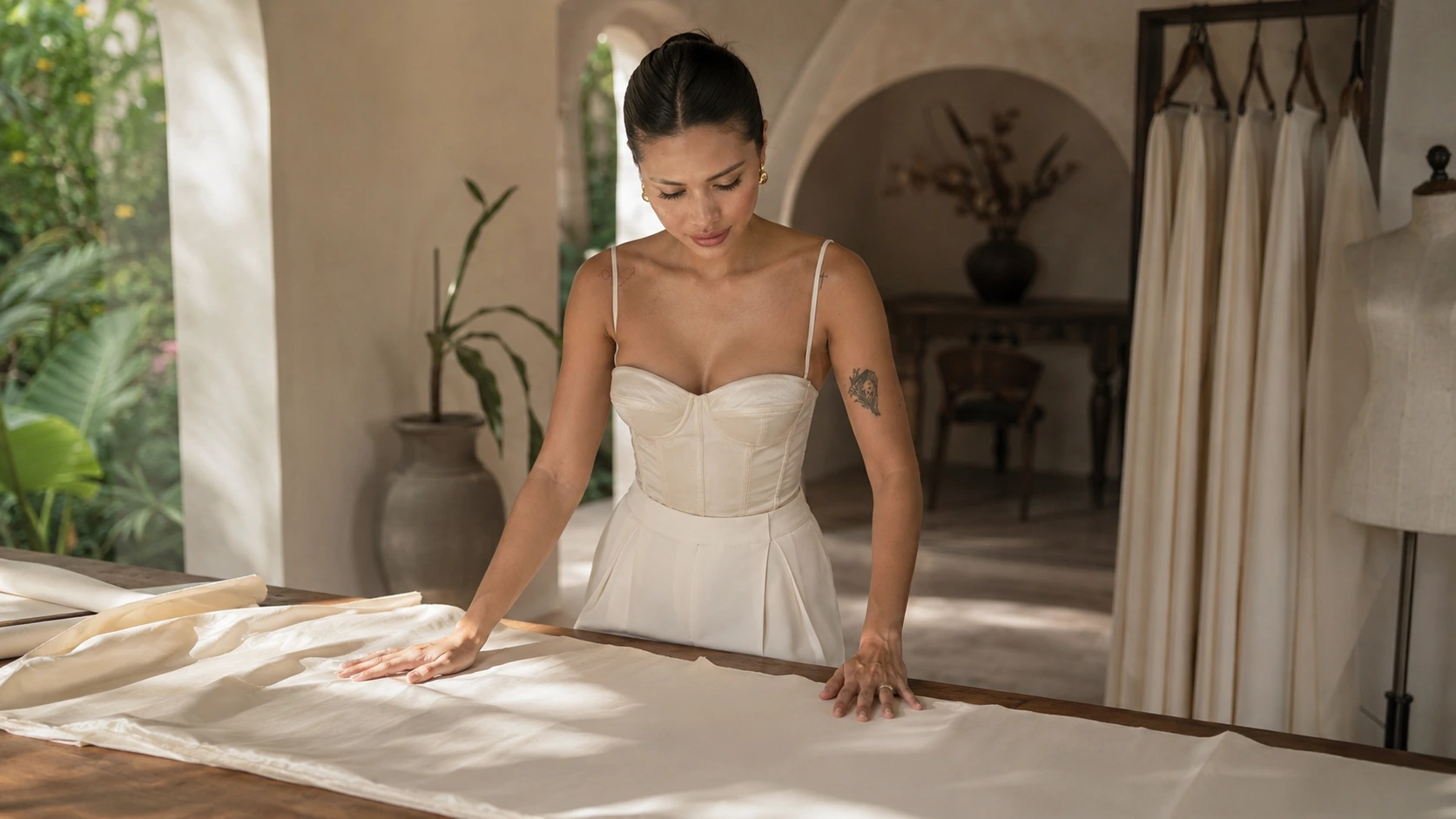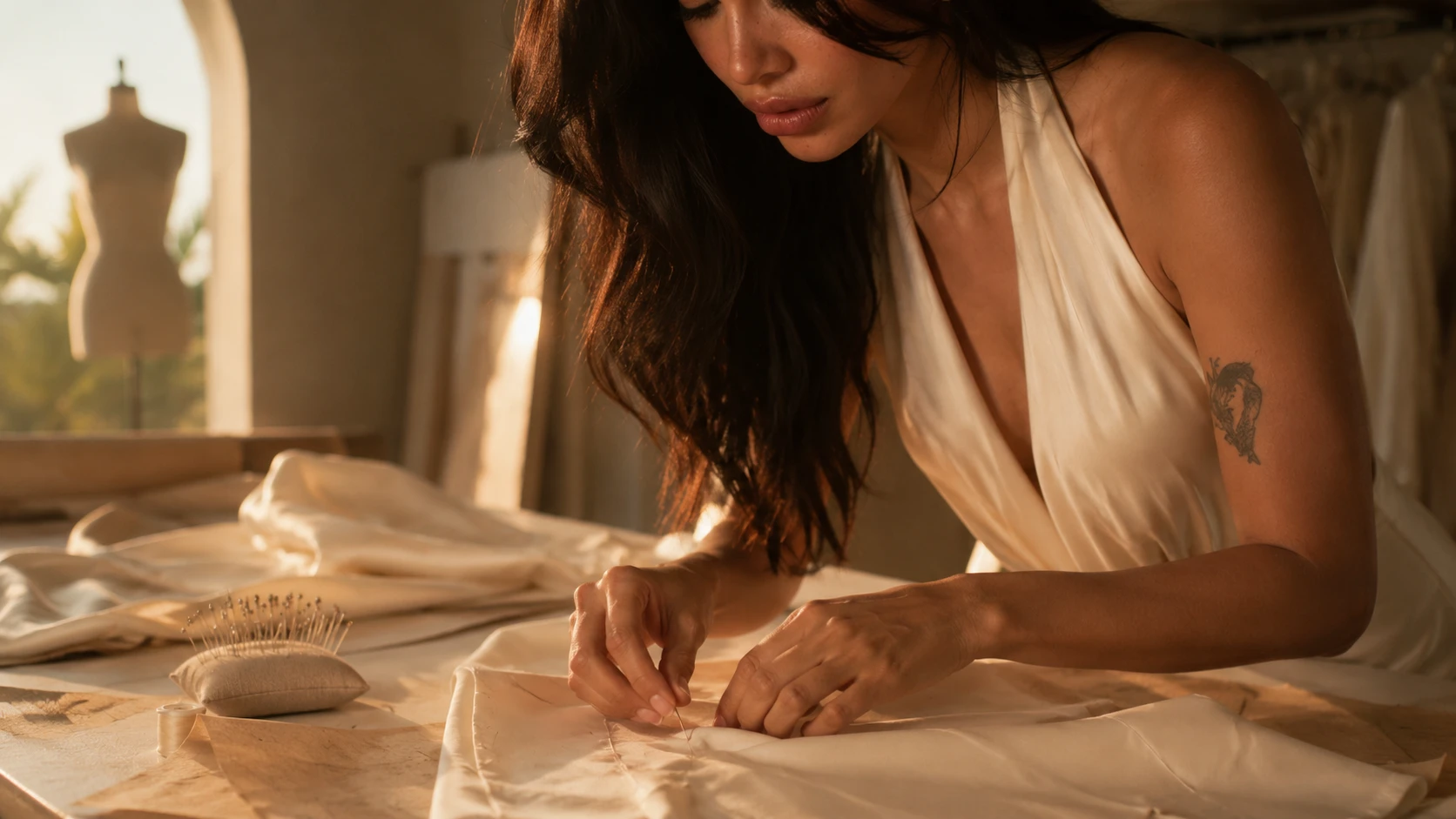
Every Maison YAYA piece passes through several pairs of hands — the cutter, the tailor, the finisher, the embroiderer. Meet the makers and the marks they leave.
There is a comforting fiction in luxury that a garment springs whole from a single designer's imagination. The truth is more humbling and more beautiful: a couture piece is a collaboration between several pairs of hands, each leaving a mark only the others can read. To wear it well is to wear all of them.
A single tailored gown might pass through four or five people on its way to the body, and each one inherits the work of the last like a relay. None could do the others' part; none works alone. What looks, on the rail, like the vision of one designer is in truth a chain of trust — every maker handing the cloth forward in the confidence that the next pair of hands will honour what they began.
The cutter, who decides everything before anyone sews
The cutter holds the most quietly powerful role in the atelier. By the time the shears close, the fall of the skirt, the way the bias will drape, whether the stripe will meet itself cleanly at the side seam — all of it is already decided. A great cutter reads grain the way a sommelier reads a vintage, by hand and by instinct. Ours can tell warp from weft with her eyes closed, by drawing a thumbnail across the cloth and listening.
The tailor, who builds the architecture
Where the cutter works in two dimensions, the tailor works in three. The tailor builds the hidden interior of a jacket — the canvas, the chest piece, the roll of the lapel — that the eye never sees but the body always feels. This is the difference between a jacket that sits on you and a jacket that is on your side. It is slow, structural, almost architectural work, and it cannot be faked by fusing.
“I can recognise the work of each of my tailors with my eyes closed, simply by feeling the inside of a lapel. The hand leaves a signature there that no label ever could.”
Yaya, Founder & Creative Director
The finisher, who makes the invisible perfect
The finisher does the work no customer is meant to notice, and that is exactly the point. Hers is the discipline of the unseen — the hand-fell of a lining, the bar tack at the base of a pocket, the slip-stitched hem that shows nothing from the right side. The deepest measure of a couture house is not its embroidery but the quality of the work it hides.
The embroiderer, who works in patience
Embroidery is the only part of a garment where time is meant to be visible. A hand-embroidered panel may hold a hundred hours of a single person's attention, and that attention is the ornament — far more than the thread itself. Our embroiderers in the north of Thailand work in a tradition passed mother to daughter, and they will tell you that the work teaches the hand its own patience.
How to read the marks
If you ever want to know whether a garment was truly made by hand, the evidence is there for the reading. Turn it inside out and look for these:
- Slight, living irregularity in hand-stitching — the marks of a human pace, never the flawless monotony of a machine.
- A lining that is fastened to the garment only at points, free to move, rather than bonded edge to edge.
- Pick-stitching along a lapel edge, tiny and barely visible, done by hand to hold the layers without flattening them.
- Seam allowances finished by hand and pressed open, not overlocked in a single rushed pass.
These are not flaws to be corrected. They are the fingerprints of the people who made the thing, and they are the surest proof that a person, and not a process, brought it into being. A pattern that is identical at every point, edge to edge, with no variation in tension or pace, is the signature of a machine — and a machine, however precise, makes nothing that belongs to anyone. The small living unevenness of the hand is the opposite: it tells you a particular person sat with this particular garment for a particular stretch of hours.