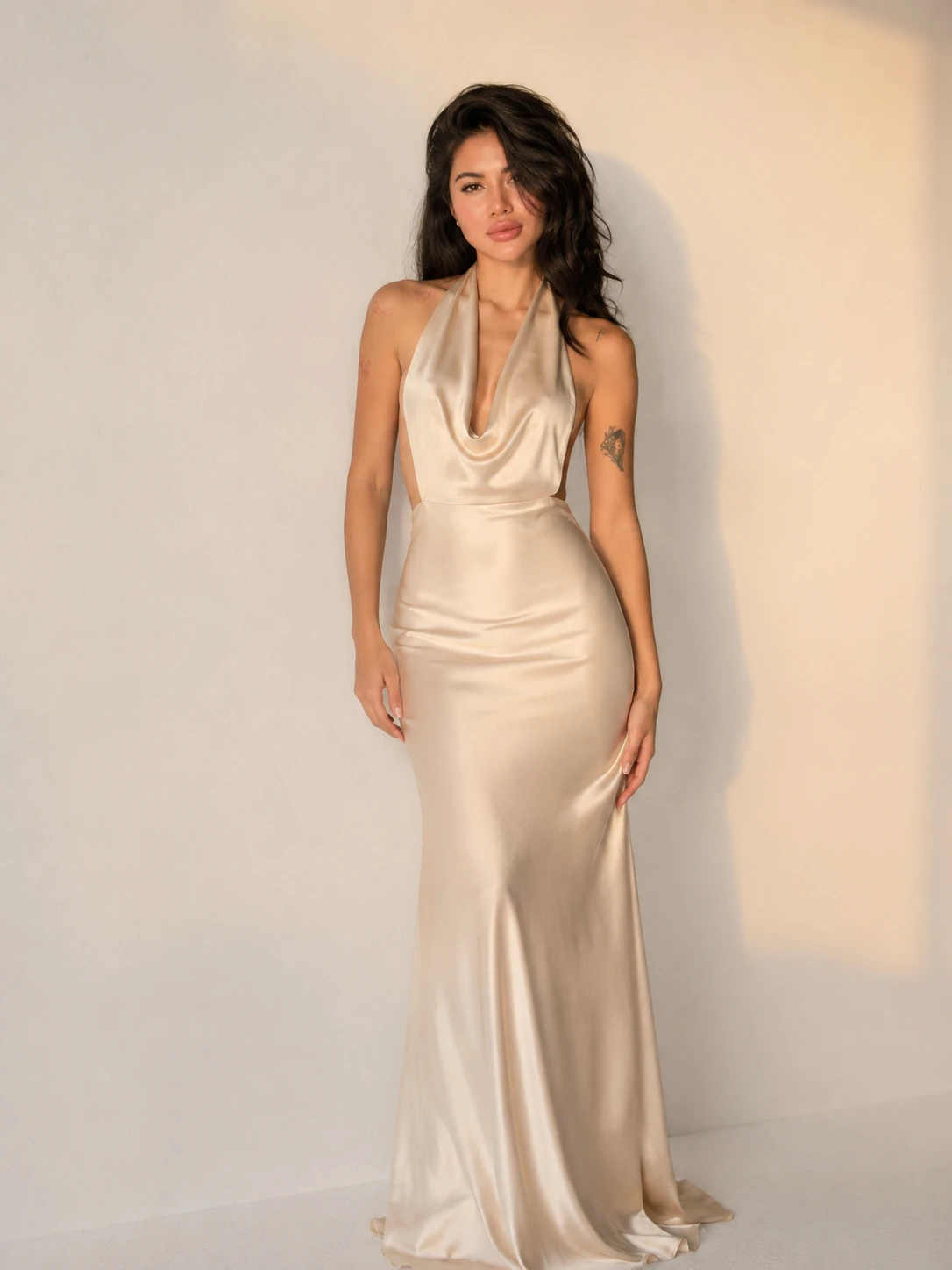
Someone always pays for fast fashion's low price — a river, a worker, a season's landfill. An unsparing look at the bill that never reaches the buyer.
A dress can be made and sold for the price of a coffee. This is presented as a marvel of efficiency, and in a narrow sense it is. But no garment is actually that cheap to bring into the world. When the buyer pays so little, the difference has not vanished — it has merely been moved somewhere she cannot see it. The price is honest. The bill is not.
The first to pay are the hands
A garment that costs five dollars on the rail leaves only cents for the person who sewed it. Across the great garment towns of the world, that arithmetic resolves into long shifts, unsafe rooms and wages that do not reach the cost of living in the same city. The buyer's saving is real. It was simply taken out of someone else's day. We learned this lesson collectively and at terrible cost more than a decade ago, and the temptation to forget it is exactly as strong as the discount.
“When a thing is too cheap to be possible, look for who is paying the part of the price you are not. There is always someone. There is always a river.”
Yaya, Founder & Creative Director
Then the water pays
A single conventional cotton dress can consume thousands of litres of water across its growing and dyeing — water drawn from places that have little to spare. The dye that gives a fast garment its colour is frequently flushed into the nearest canal, and downstream the colour of next season runs in the river before it runs on the rack. The garment is cheap because the water was treated as free, and it never is.
And finally the future pays
The cruellest economy of fast fashion is how briefly it is wanted. A piece designed to be irresistible in March is designed, just as deliberately, to look wrong by June — so that the cycle, and the spending, begins again.
- A garment truckload of textiles is landfilled or burned somewhere in the world roughly every second — most of it barely worn.
- Synthetic clothes shed plastic microfibres in every wash, threads of which now reach the most remote water on earth.
- Clothing donated in good faith routinely outpaces any possible demand and ends as waste mountains in countries that never bought it.
- The cheaper the garment, the shorter its life — the two are not a coincidence; they are the business model.
What it means to pay the price in full
Luxury, properly understood, is simply a garment whose bill is paid honestly and at the counter — a fair wage in the price, a clean dye in the cloth, a longevity that keeps it out of the ground. It costs more because nothing about it has been quietly externalised onto a worker, a river or a landfill. That is not an indulgence. It is the receipt, paid in full, for a thing that exists without harm hidden inside it.
At Maison YAYA we make few things and we make them to be kept. The price we ask is higher, and it is the whole price. We would rather you understood exactly what you were paying for than offered you a number with the truth taken out of it.