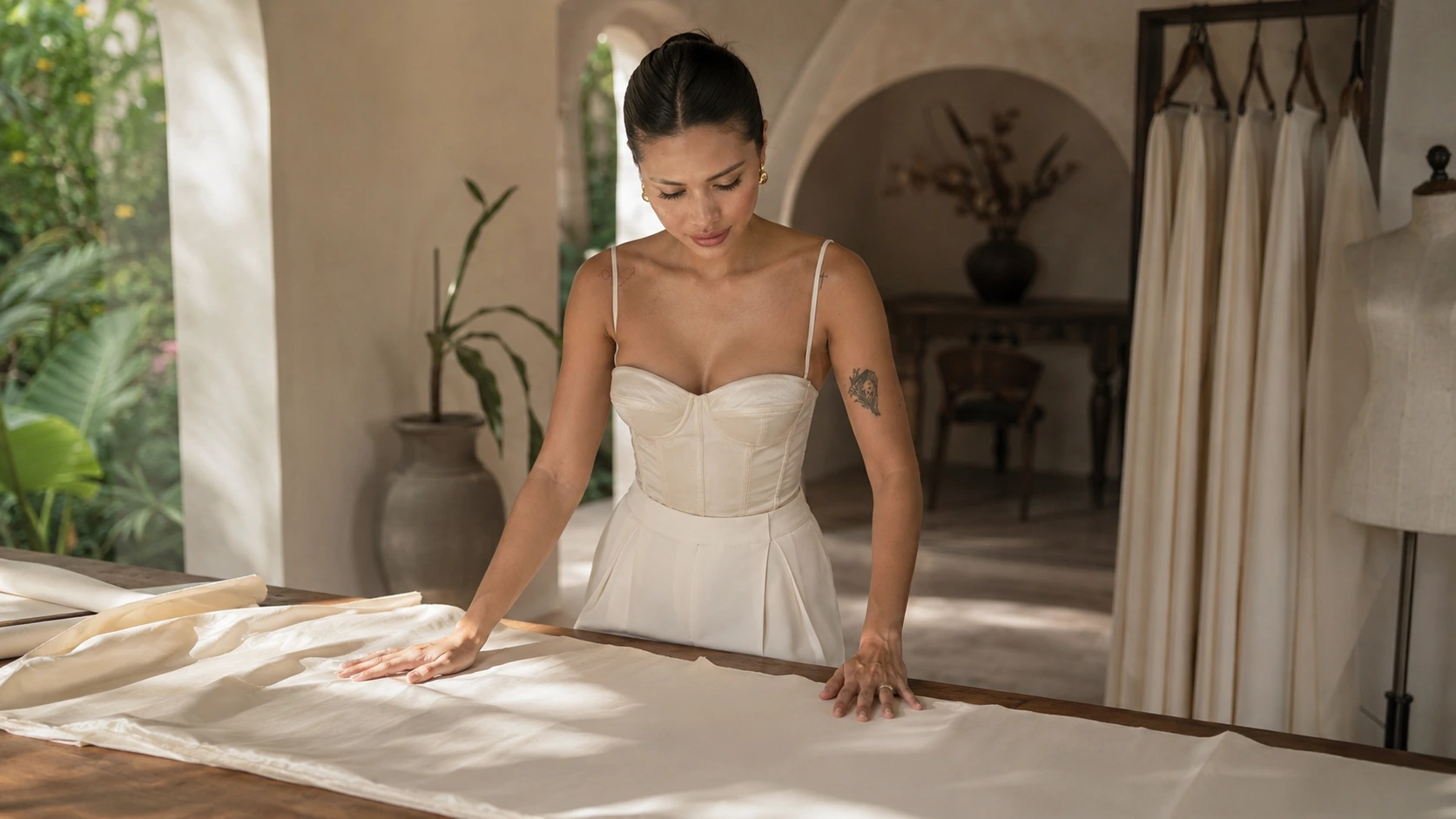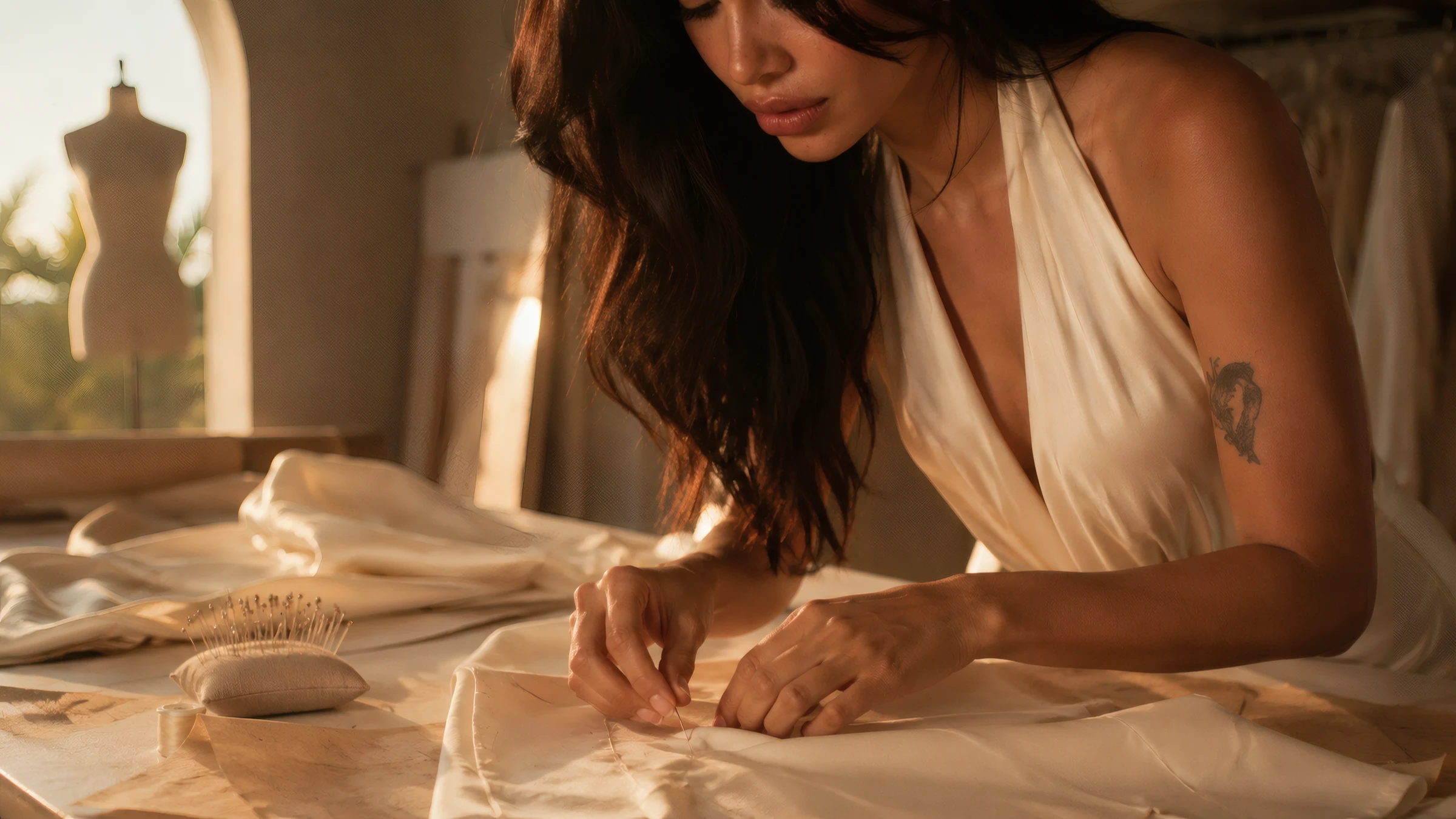
How does a flat sheet of silk become a living silhouette? The geometry of turning two dimensions into three — and why ease, not measurement, is the secret.
There is a moment in the atelier that never loses its quiet drama: a flat pattern is cut from cloth, the pieces are joined, and a shape that lay lifeless on the table suddenly stands up and holds the form of a body that is not there. This is the central miracle of patternmaking — the passage from two dimensions to three — and it rests on principles every thoughtful wearer can learn to see.
The impossible flattening
Cartographers have known for centuries that you cannot flatten a sphere without distortion — every world map lies somewhere. The patternmaker faces the same problem in reverse: how to draw flat shapes that will curve into a body when joined. The body cannot be unrolled onto paper cleanly, so the pattern is full of deliberate compromises — darts that fold the excess away, seams that bend, curves that look wrong on the table and right on the form. A flat pattern is never a literal map of the body. It is a clever fiction that becomes true only once it is sewn.
“On the table the pattern looks like nothing — odd shapes, strange curves. You have to be able to see the woman inside the flat. That is the whole skill.”
Yaya, Founder & Creative Director
Ease — the space the body needs to live
A common mistake is to think a garment should match the body's measurements exactly. It must not. Between the body and the cloth there is always ease — a measured margin of extra room — and getting it right is the difference between a garment and a costume. There are two kinds, and the atelier weighs both on every piece:
- Wearing ease — the minimum room the body needs simply to breathe, sit, reach and move. Too little and the garment strains; too much and it looks borrowed.
- Design ease — the deliberate extra fullness that creates a silhouette: the gentle drape of a relaxed trouser, the soft blouse over the waistband, the languid fall of an unbelted coat.
- Negative ease — rarer, used only with cloth that stretches or on the bias, where the garment is cut slightly smaller than the body and asked to cling.
Curves that must agree
When two pattern pieces meet — a sleeve into an armhole, a side front into a side back — their edges are rarely the same length. The sleeve cap is usually longer than the armhole it must fill, and that extra length is eased in: distributed as imperceptible fullness so the sleeve curves over the shoulder without a single pleat or pucker. This easing of one curve into another is among the most demanding things a sewer does, and it is dictated entirely by how the patternmaker drew the two curves to relate. The geometry on paper decides whether the shoulder will be smooth or troubled.
Why the toile comes before the silk
Because the leap from flat to form can never be fully predicted on paper, the maison never cuts precious cloth first. Every pattern is first made up in calico — an inexpensive cotton toile — and fitted on the form and then a living body. Here the pattern reveals its truths: where it pulls, where it bags, where a curve needs a few millimetres more. Only when the toile is right is the pattern trusted, and only then does the royal-grade Thai silk leave the drawer. The flat has proven it can become form, and the form has proven it deserves the cloth.
To wear a well-made garment, then, is to wear a resolved argument between flat and round — an argument the patternmaker won so completely that you will never know it was had.