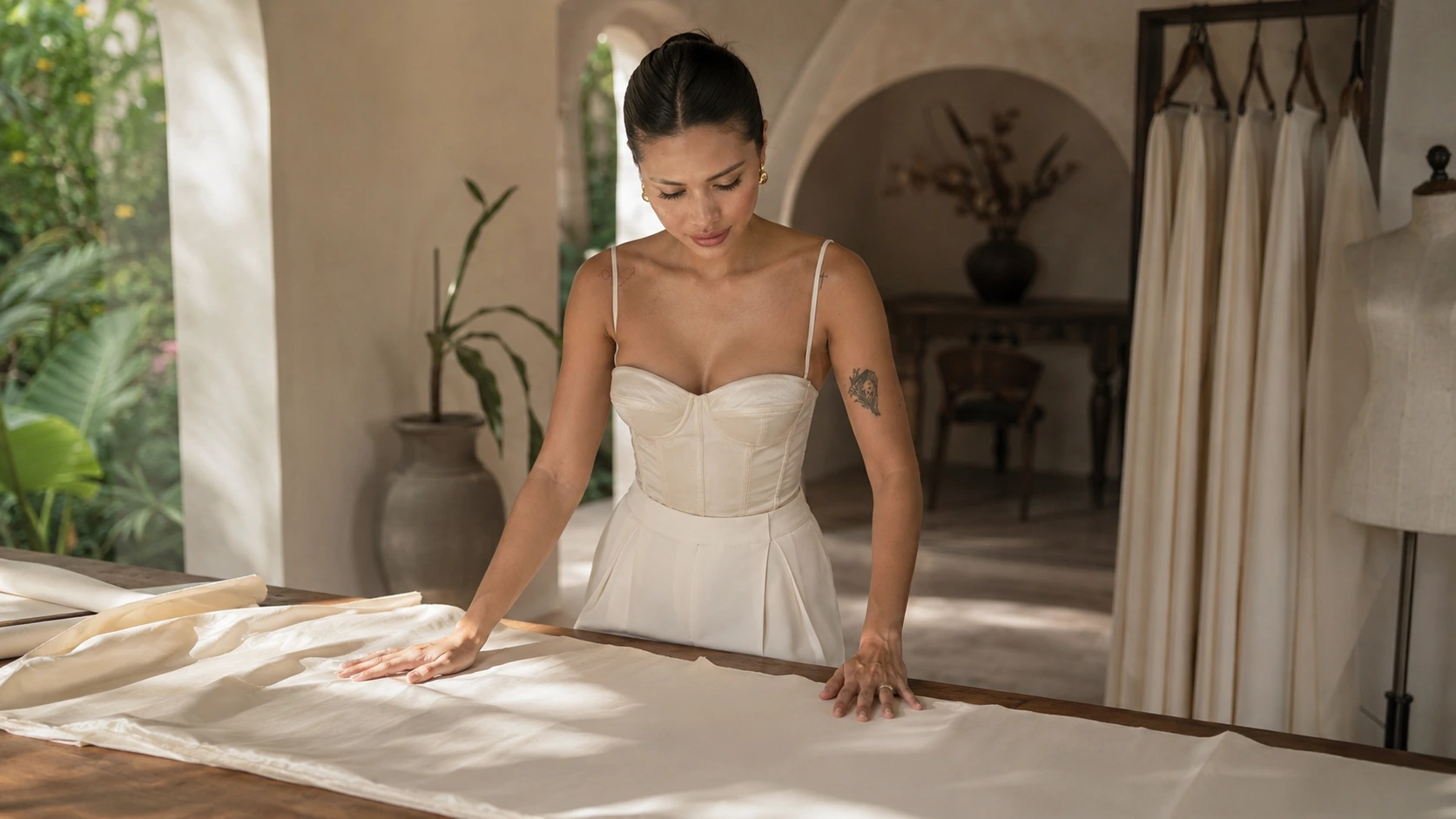
Balance is the quality you feel before you can name it — the reason a jacket hangs serene and still. A study of front and back balance, and how tailors find a garment's equilibrium.
There is a quality in a great jacket that women sense long before they can name it. It hangs serenely. It does not pull forward at the neck or swing back at the hem. It sits in stillness, as though the cloth had found its own centre of gravity and decided to rest there. Tailors call this balance, and of all the things that make a garment beautiful, it is the most invisible and the hardest to achieve.
What balance really means
Balance is the relationship between the front of a garment and the back — specifically, whether the cloth is the right length over each to let the whole thing hang plumb from the shoulders. Imagine an invisible plumb line dropped from the base of the neck. In a balanced jacket the cloth falls cleanly along that line, front and back, with no fighting. When the balance is off, the garment tries to correct itself by tilting, and you see the evidence everywhere: a collar that floats away, a hem that dips, lapels that will not lie still.
“Fit makes a garment touch the body correctly. Balance makes it hang from the body honestly. They are not the same thing.”
Yaya, Founder & Creative Director
The two ways it goes wrong
There are two classic faults, and learning to recognise them changes how you see clothes forever:
- Too short in the back — the jacket pulls upward behind, the collar rides away from the neck, and the front hem swings forward and low, like the garment is being tugged from behind.
- Too long in the back — surplus cloth pools and folds across the lower back, the back hem dips toward the floor, and the front rides up.
- An honest test: stand the wearer still, step back, and check whether the hem is parallel to the floor all the way round. A level hem is balance made visible.
Why posture decides everything
Balance is not a property of the jacket alone; it is a conversation between the jacket and a particular body. A woman who stands very upright, or one with a forward head, or one with a pronounced curve to the lower back, each needs a different distribution of cloth front to back. This is why the same beautifully made jacket can hang perfectly on one woman and tilt uneasily on another of identical measurements. They have the same numbers and different postures. Tailoring answers to posture, not to the tape alone.
How the tailor finds it
Balance is set early and corrected in the cloth. At the first fitting, with the garment still in its raw, basted state, the tailor reads how it hangs on the living body — where it pulls, where it pools — and lifts or lowers the back at the shoulder seam by tiny amounts until the plumb line is found and the hem comes level. It is patient, almost meditative work, done by eye as much as by rule. A millimetre at the neck travels into centimetres at the hem.
Learning to feel it for yourself
You do not need a tailor's vocabulary to use this knowledge. The next time you try a jacket, resist the mirror's seduction of the front view. Turn side-on. Ask a friend to look at the back. Is the collar resting calm against your neck? Is the hem level? Does the whole garment look like it is standing still, or like it is quietly straining to right itself? That stillness — that sense of cloth at rest — is balance, and once you can feel it, you will never again mistake a flattering jacket for a well-made one.