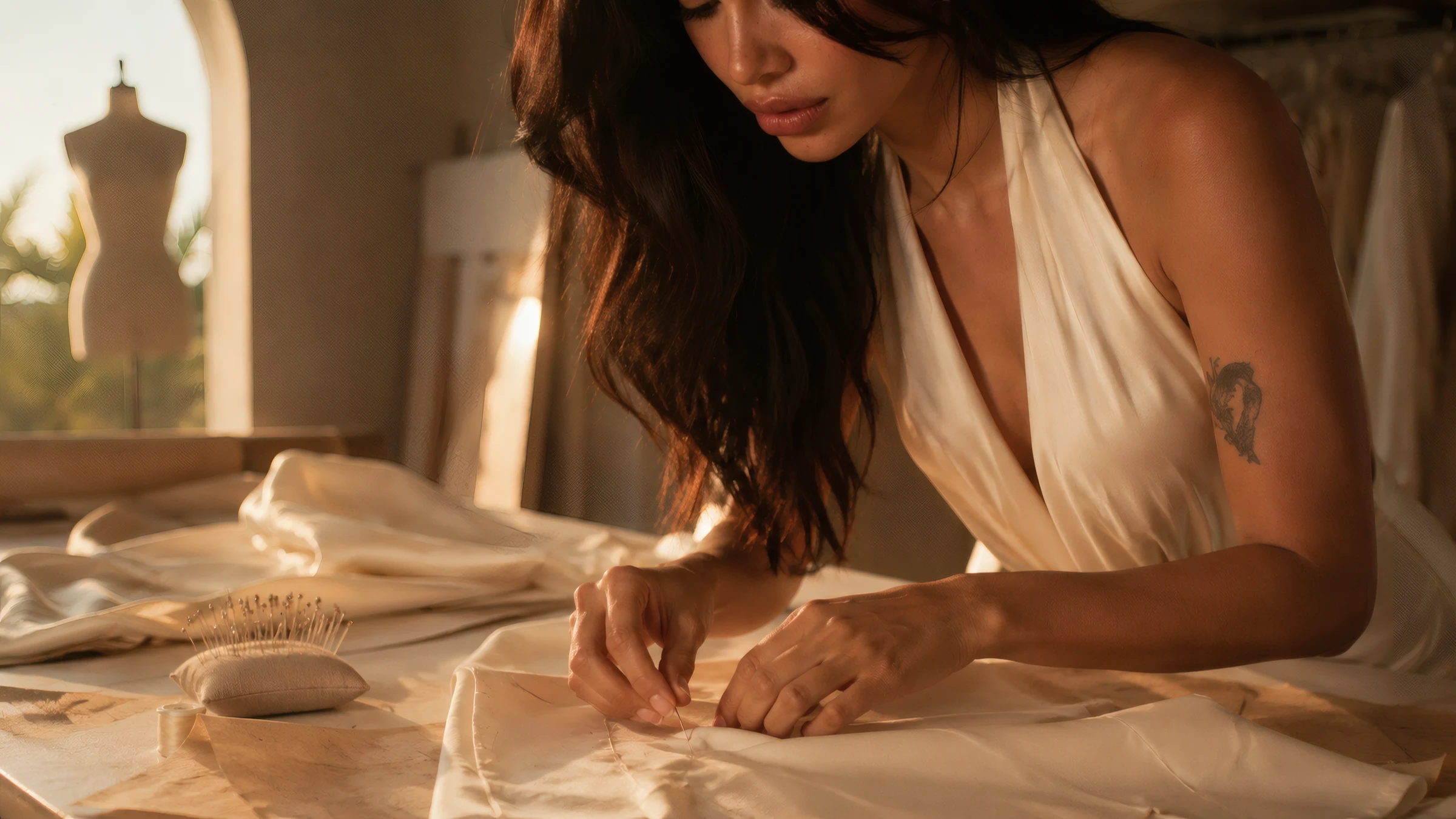
The history of haute couture, from Charles Frederick Worth signing his gowns to the legal birth of the term — and why a 19th-century idea still rules fashion.
Before 1858, a dress had no author. A woman of means brought her own cloth to a dressmaker and dictated what she wanted; the seamstress executed it, anonymous and unsigned, a pair of hands fulfilling an order. Then an Englishman in Paris turned the order around. He proposed the designs. He chose the fabrics. He showed finished gowns on live models — the first mannequins — and let the client select. And, most radically, he sewed his name into the lining. His name was Charles Frederick Worth, and with that signature, the designer was born.
The House of Worth and the birth of the idea
Worth opened his house on the Rue de la Paix and dressed the empress Eugénie, which made him dress all of Europe. What he invented was not a stitch but a relationship: the couturier as the authority, the woman as the patron of a vision rather than the director of a task. He presented seasonal collections. He built an atelier of specialised hands. The grammar of fashion as we still speak it — the house, the collection, the name above the door — is essentially his.
When the words became law
For decades, anyone could call their work couture. That ended in 1945, when the French authorities, together with the Chambre Syndicale, codified exactly what haute couture meant and who could claim it. The criteria were demanding by design: a Paris atelier, a minimum staff of trained artisans, garments made to order for private clients across multiple fittings, and a formal collection shown twice yearly. The phrase became a protected appellation, like Champagne — a guarantee, not a flourish.
- 1858 — Charles Frederick Worth opens in Paris and signs his gowns, inventing the designer as author.
- 1868 — The Chambre Syndicale is founded to govern and protect the trade.
- 1945 — Haute couture becomes a legally regulated term with formal entry criteria.
- 1947 — Dior's New Look proves a single couture collection can reset the silhouette of an entire decade.
The golden age and the great reset
The post-war years were couture's high noon. In 1947, a young Christian Dior showed a collection of nipped waists and extravagant skirts so opposed to wartime austerity that an American editor called it the New Look, and the name stuck to the entire era. A single Paris collection had, in an afternoon, told women across the world what shape they would be for the next ten years. No medium before or since has held that kind of quiet authority over how people dress.
“Couture began the day a man dared to put his name where only the wearer's body had been. Everything since is a footnote to that audacity.”
Yaya, Founder & Creative Director
Why a 19th-century idea still rules
Today only a handful of houses hold the official designation, and the economics rarely close — a couture collection is, for most maisons, a loss leader for perfume and bags. And yet it persists, because it preserves something nothing else does: the knowledge in the hands. The embroiderer trained over a decade, the flou worker who can fell a chiffon hem you will never see, the pattern cutter who reads a body like a map. As long as those hands are paid to work at the height of their craft, the idea Worth lit in 1858 stays alive — and every ready-to-wear garment with real care inside it is warmed by that same flame.
At Maison YAYA we are not a Paris couture house and we will never claim the protected words. But we keep the lineage in mind with every toile we cut in Phuket — because the discipline Worth founded is the reason a garment can still be, in the oldest sense, made for a person.