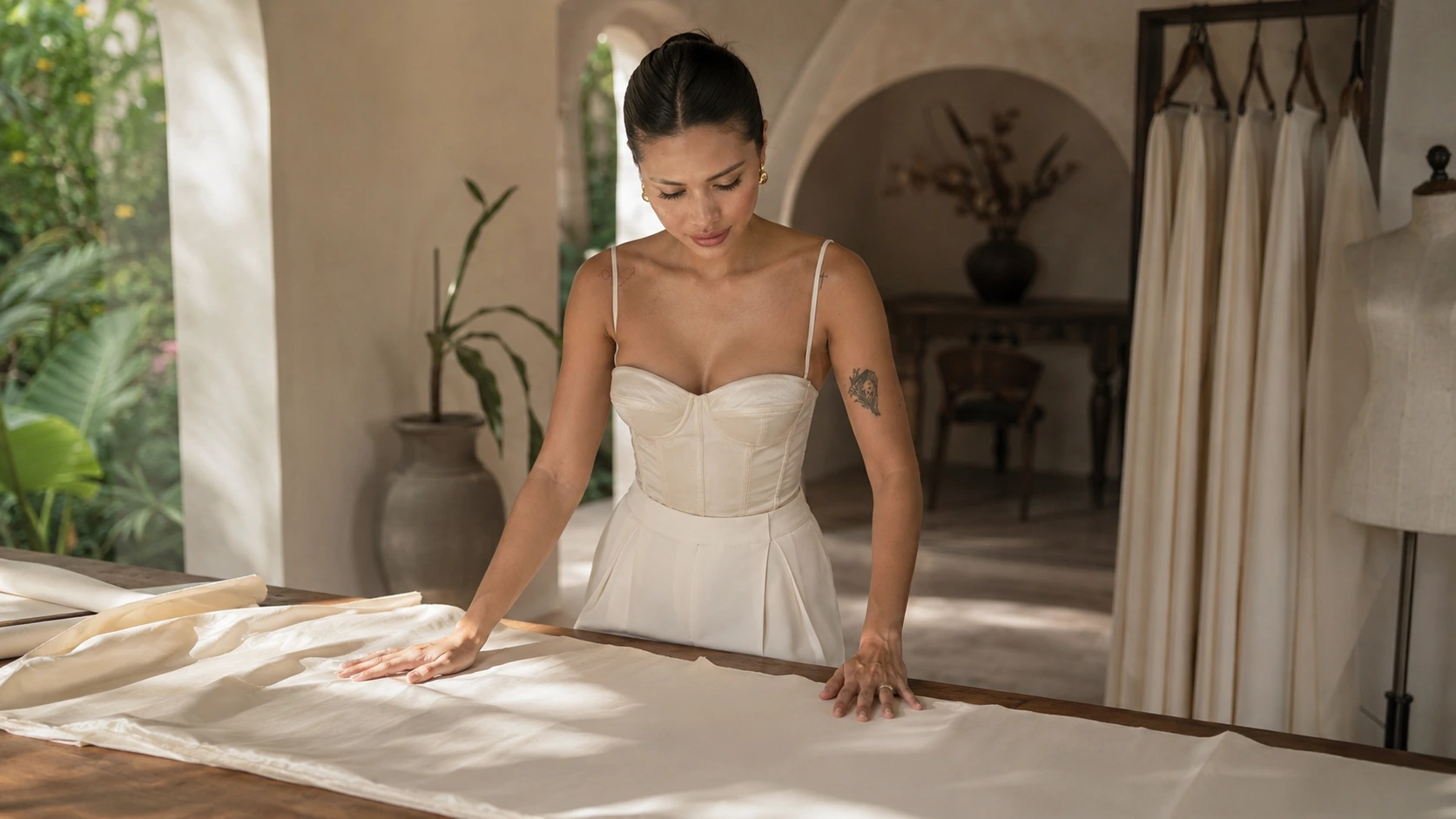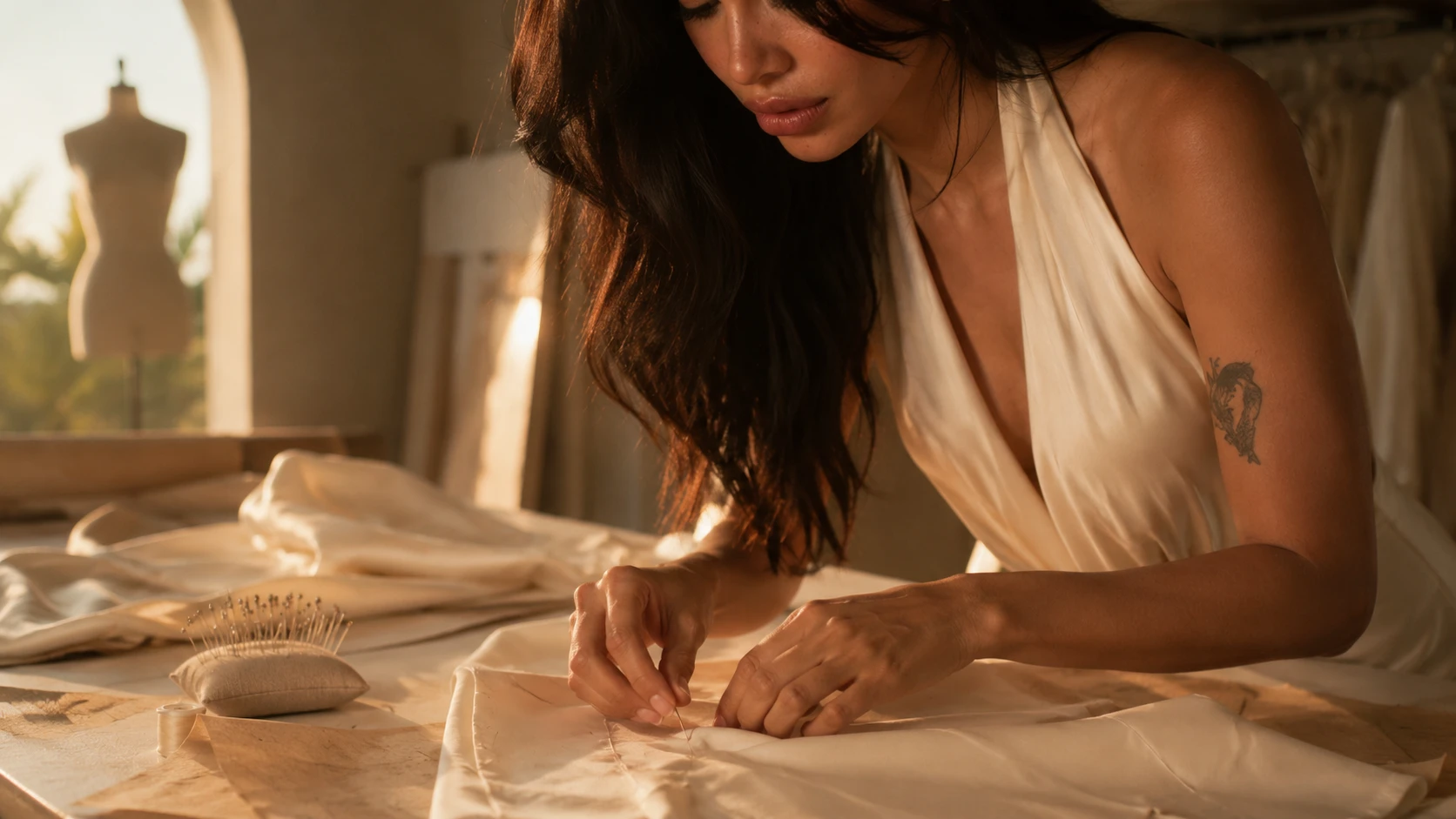
Tailor's shears, the ham, the point presser, the thread that disappears — a guided tour of the humble, exacting tools behind every couture garment.
Walk into a couture atelier expecting glamour and you will be disappointed. The tools of the trade are almost ascetic — wooden, steel, unbranded, often older than the people using them. Their beauty is entirely in their fitness for purpose. Here are the instruments we could not work without, and why each one earns its place on the table.
The shears, which are never lent
A pair of true tailor's shears is the single most personal object in the atelier. Bent-handled so the lower blade glides flat along the table without lifting the cloth, heavy enough to cut by their own weight, they are sharpened by one person, oiled by one person, and used by one person. The oldest superstition in tailoring is also the most practical: you never lend your shears, and you never cut paper with them. Paper dulls a blade that took years to learn the feel of. Drop a pair and the whole room flinches.
The pressing tools, where shape is truly made
Customers imagine garments are built with needles. They are built, just as much, with steam. Tailoring is half sewing and half pressing, and the pressing tools exist to mould flat cloth into the curves of a living body:
- The tailor's ham — a tightly stuffed cushion, curved like its namesake, over which a dart or a curved seam is pressed so the shape is set into the cloth, not flattened out of it.
- The sleeve roll, a firm sausage of a cushion that lets a sleeve seam be pressed open without creasing the tube of fabric around it.
- The point presser, a narrow wooden tool for pushing open the seams of a collar point or a lapel where no iron could reach.
- The clapper, a smooth block of hardwood pressed onto steamed cloth to hold the heat and flatten a seam to a knife-edge as it cools.
“A young tailor wants to sew. I make them press for a season first. You cannot build shape until you understand that the iron, not the needle, is what teaches cloth to hold a curve.”
Yaya, Founder & Creative Director
The thread that is meant to vanish
Silk thread occupies a special place on the table. It is finer and stronger than cotton, it sinks into a seam and seems to disappear, and crucially it gives a little — it relaxes with the cloth rather than sawing against it. We use it for basting, because it pulls out cleanly without leaving holes, and for the finest hand-finishing, where the goal is a stitch the eye refuses to find.
Chalk, the most disposable and most exacting tool
Tailor's chalk seems too humble to mention, and yet a whole garment's accuracy rests on it. It must mark a clean, fine, visible line and then leave no trace once pressed. We keep ours sharpened to a chisel edge like a pencil, because a chalk line two millimetres too thick is two millimetres of doubt about where the seam truly lives. The cheapest thing in the room demands some of the most discipline.
The wooden ruler and the tape that knows the body
Two measuring tools, two philosophies. The clear wooden ruler and the L-square serve the flat world of the pattern, where everything is true and square. The soft tape measure serves the round world of the body, where nothing is. A good fitter moves fluently between the two — and never quite trusts a body to match a pattern until the toile is on it.
None of these tools is expensive. None is rare. What makes them precious is the years of touch stored in them — the way a maker's shears have worn to her grip, the way a ham has taken the shape of ten thousand pressed darts. In a couture atelier the tools are not the magic. They are the means by which patient hands make the magic, the same way they have for a hundred years.