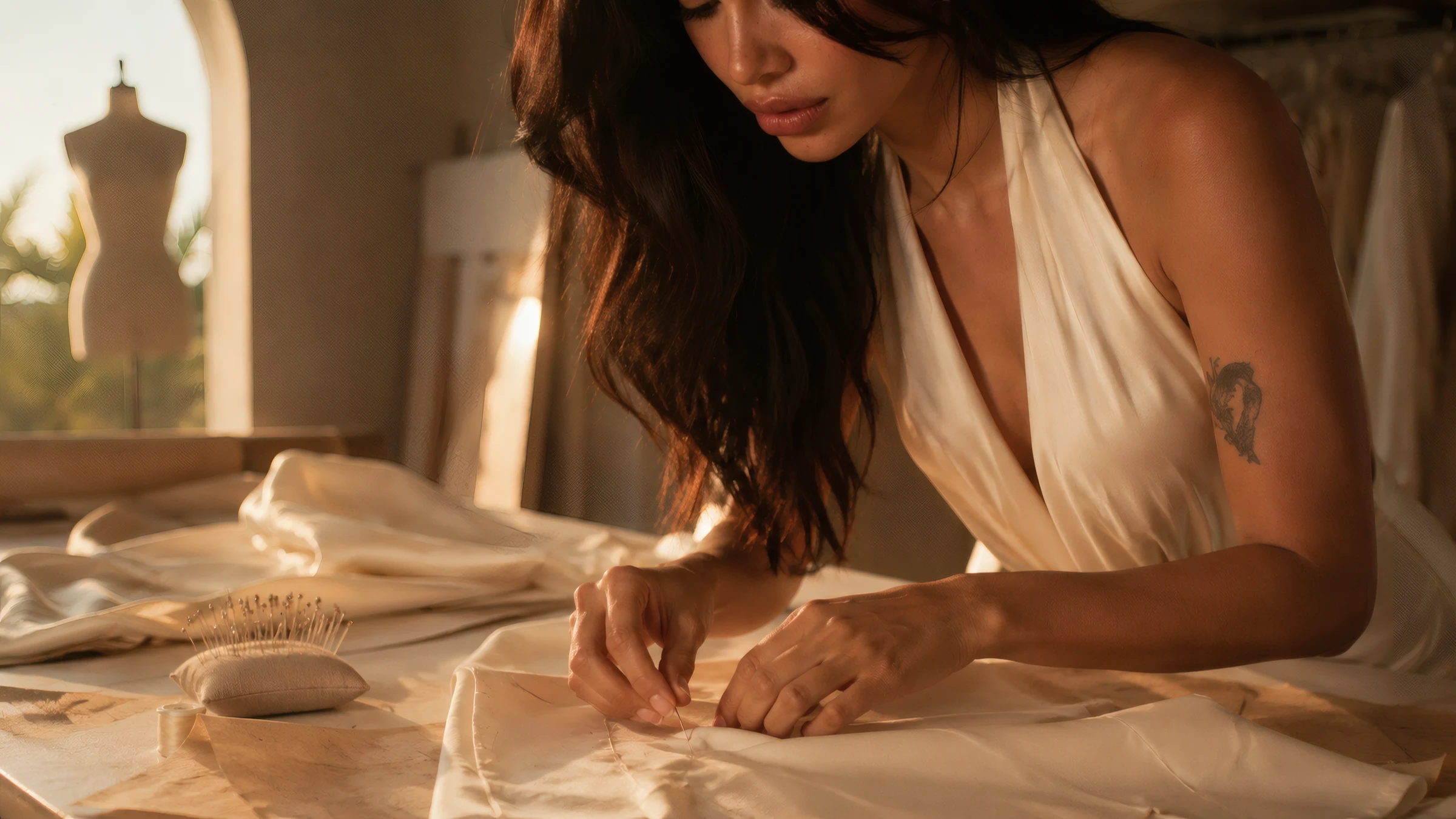
What actually makes a garment couture — hand-felled seams, an inner architecture of canvas and horsehair, and the tells you can find by turning a piece inside out.
Ask ten people what makes a dress couture and most will point to the surface — the embroidery, the silk, the name. But couture lives where no one looks. Turn the garment inside out and the truth is laid bare: an interior architecture, built entirely by hand, that holds the outer shape the way a skeleton holds a body. The outside is what a dress shows the world. The inside is what it confesses to the woman wearing it.
The seam tells the story
Begin with a single seam. In ready-to-wear it is overlocked — bound by machine in a tight zigzag that finishes the raw edge quickly and cheaply. In couture the same seam is pressed open and each side felled by hand with stitches so small they vanish, or bound in a strip of self-fabric or silk organza. It takes a skilled hand the better part of an hour to do what a machine does in seconds. The result does not merely look better. It moves better, lies flatter, and ages without fraying.
The hidden architecture
A couture jacket is not one layer but several, and the layers you cannot see are the ones doing the work. Between the wool and the lining sits a canvas — often horsehair and wool — that is not glued but pad-stitched by hand, thousands of tiny diagonal stitches that coax the cloth into a three-dimensional curve it could never hold on its own. This is why a true tailored shoulder rolls and a fused one merely sits. Inside an evening gown, the same principle takes a different form: a built-in corselette, boned and bound, so the dress supports the body rather than relying on it.
- Seams pressed open and felled or bound by hand, never simply overlocked.
- An interior canvas pad-stitched by hand to shape the cloth in three dimensions.
- An inner foundation — corselette, boning, waist-stay — so the garment holds itself.
- Hems caught with invisible catch-stitches; linings attached by hand, never just topstitched shut.
- A signature thread tack or maison label sewn, not heat-pressed, into the lining.
The grain knows
There is one more tell, subtler than the rest: the grain. In couture, every panel is cut so the threads of the cloth run true to the body — straight grain falling plumb from the shoulder, bias used deliberately where the fabric must hug and flow. A garment cut off-grain to save fabric will twist on the body within an hour of wear, the side seam slowly spiralling toward the front. A couture garment hangs the same at the end of the night as it did at the start. The cloth was respected, so it behaves.
“We finish the inside of a gown as though it will be photographed. No one will ever see it but the woman it belongs to — and she is the only audience that matters.”
Yaya, Founder & Creative Director
How to test a garment yourself
You do not need an atelier to read these things. In any boutique, turn a jacket inside out and look for hand-felled seams and a soft, un-fused front. Pinch the shoulder: a hand-canvased one yields and rolls; a fused one feels like card. Hold a gown by its waist and feel for the quiet rigidity of an inner stay. Check whether the hem stitches show through to the right side. The garment will answer every question honestly, because unlike a price tag, construction cannot lie.
At Maison YAYA we build to this standard wherever a piece earns it — our tailored jackets are hand-canvased, our evening pieces internally structured. We invite you to turn them inside out. The inside is where we keep our promises.