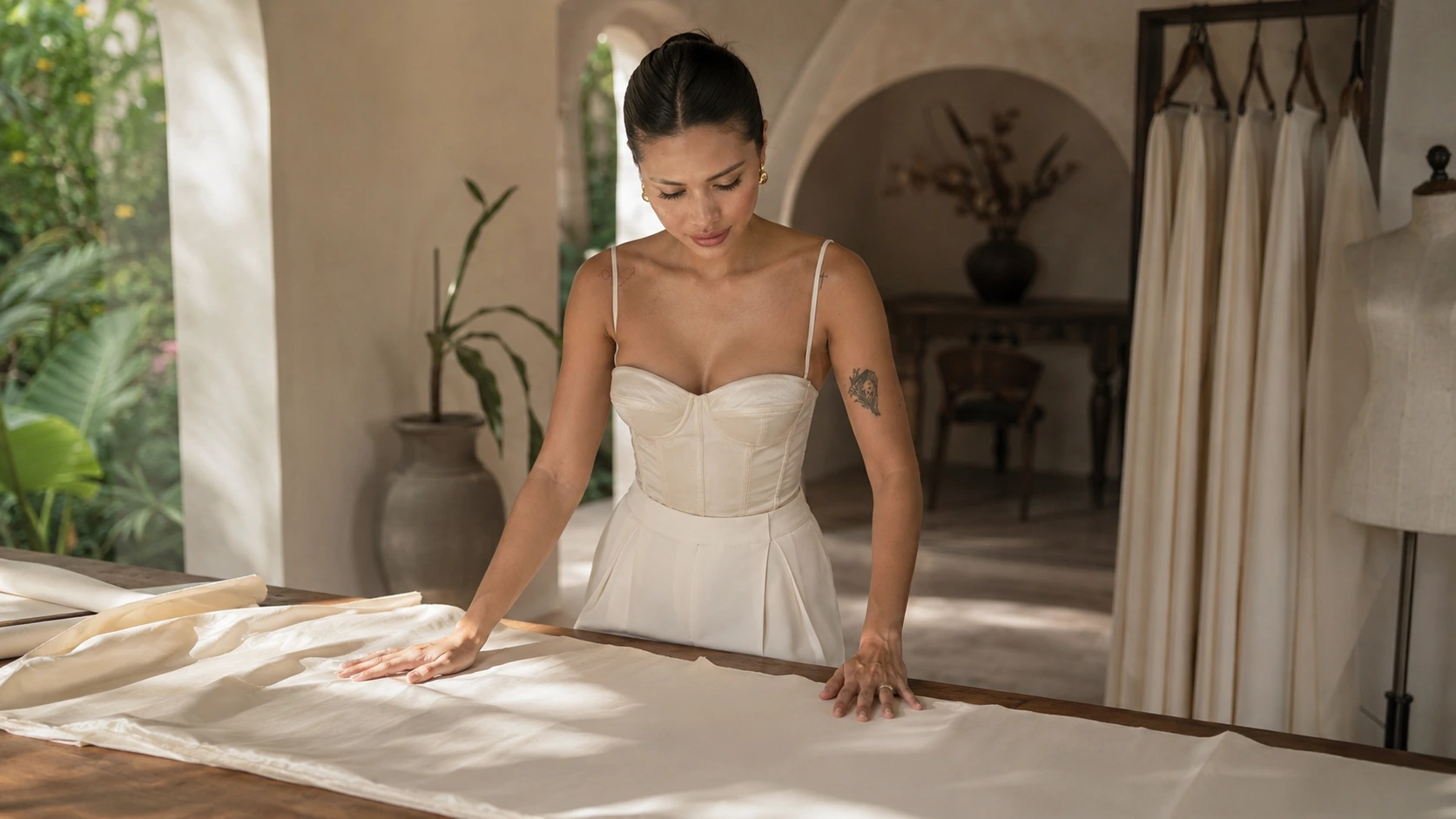
How to identify, choose and care for authentic Thai silk — mulberry vs. raw silk, the weight and hand of true Bombyx mori, and why the maison cuts from royal-grade Thai cloth.
Silk is the only fibre that holds a thought. A guide for women who want to know — really know — what they are wearing.
The two silks that matter
In Thailand, almost everything called "silk" falls into two families. Mulberry silk is woven from the cocoon of the Bombyx mori moth, fed exclusively on mulberry leaves. The thread is long, uniform, and reflective — the basis of every weight you think of as "luxury silk." Raw silk (or doupioni, when the thread is reeled from a double cocoon) keeps the natural irregularities of the fibre: tiny slubs, a drier hand, a softer shine. Neither is better than the other. They are different architectures.
How to identify authentic Thai silk
Four tests, in the order we use them in the atelier:
- The weight test. Authentic mulberry silk has weight you can feel in your fingertips — between 16 and 22 momme for a gown, 22 to 30 for trousers. Polyester imposters feel suspiciously light.
- The warmth test. Hold the fabric in a closed palm for thirty seconds. Real silk warms to body temperature and stays warm. Synthetics cool again the moment you open your hand.
- The shine test. Tilt the fabric under a single light source. True silk shifts colour — a champagne reads as gold then ivory as the angle changes. Polyester shines the same colour at every angle.
- The burn test. Reserved for swatches, never garments. A single thread from silk burns to a fine grey ash that crumbles between your fingers and smells of singed hair. Polyester melts into a hard black bead and smells of plastic.
How to care for it
Silk is the most generous fibre in the wardrobe — provided you treat it as a living thing, not laundry. We recommend hand-washing ready-to-wear silk in cool water with a pH-neutral soap (a single capful of unscented baby shampoo is the atelier's quiet secret), rolling — never wringing — the piece in a clean cotton towel, and drying flat in the shade. Iron from the reverse side on low heat while the fabric is still slightly damp. For tailored pieces with structured shoulders or canvased linings, dry clean only.
Why we cut from royal-grade Thai silk
The Royal Thai Department of Sericulture certifies four grades — the highest is reserved for Bombyx mori cocoons reeled by hand in the northern villages where the technique is centuries old. It is, simply, the most beautiful cloth made in Asia. Maison YAYA's gowns and shirts are cut exclusively from this grade. The colour is dyed in small batches by a single family in Surin. The selvedge carries their initials.
“We do not buy silk by the metre. We buy it by the hand — by the way a length answers the light when you lift it from the table.”
Yaya, Founder & Creative Director
You can see the silks discussed here at work in the L'Aurore Spring 01 collection — particularly the Raw Silk Trousers, the Bias Silk Slip Gown, and the Hand-Loomed Silk Shirt. Or visit the showroom in Phuket: we will lay the cloth across the table and you can perform every test in this guide for yourself.