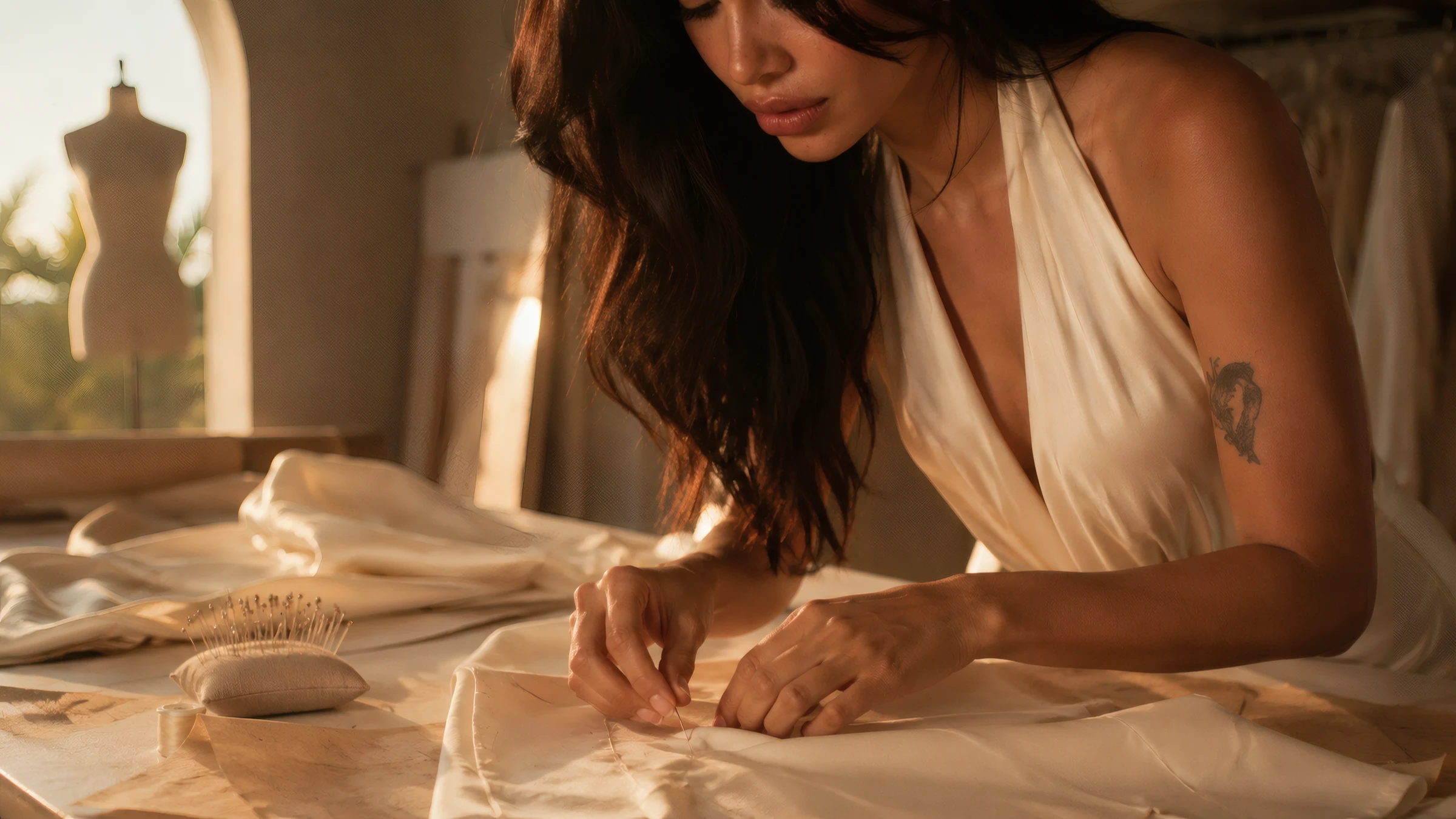
Inside the atelier flou and atelier tailleur — the two distinct workrooms of couture, why a chiffon hand cannot cut a jacket, and what each kind of skill teaches.
Every couture house is, in truth, two houses under one roof. Walk through the workrooms and you will pass through two entirely different climates of skill. In one, the air is soft: bias-cut silk, chiffon, the language of drape and flow. In the other, it is precise: wool, canvas, the geometry of structure. These are the atelier flou and the atelier tailleur, and a master of one is rarely a master of the other. The division is not bureaucratic. It runs to the bone.
The flou: the art of the soft
Flou comes from the French for blurred, soft, hazy — and it names the workroom that handles everything fluid. The flou hand makes dresses, blouses, gowns: garments that follow the body and obey gravity rather than defying it. Her great instrument is the bias, the diagonal of the cloth, where fabric stretches and clings and falls in a way it never does cut straight. She pins on the form and lets the silk tell her where it wants to go, then persuades it the last few degrees. Her stitches are weightless; a hem in chiffon must hold without ever announcing itself.
The tailleur: the art of structure
The tailleur workroom is the opposite discipline. Here the maker builds rather than drapes — jackets, coats, structured suits. The cloth is firm, the canvas is interlined, the shoulder is constructed. Where the flou hand follows the body, the tailleur hand corrects it: a quarter-inch of padding to balance a shoulder, a pad-stitched lapel coaxed into a permanent roll. It is closer to architecture than to dressmaking. A tailleur thinks in planes and angles; a flou thinks in curves and falls.
- Flou — soft, fluid garments: gowns, dresses, blouses; mastery of bias, drape and the invisible hem.
- Tailleur — structured garments: jackets, coats, suits; mastery of canvas, padding and the built shoulder.
- The flou persuades the cloth to fall; the tailleur builds the cloth into a shape.
- A single complex garment — a tailored bodice with a chiffon skirt — may pass between both workrooms.
Why the skills do not cross
It might seem efficient to train one artisan in both. In practice the hand cannot hold both grammars at once. The flou worker spends years learning to read drape, to feel when a bias seam is about to twist, to sew so lightly that silk forgets it has been touched. The tailleur spends those same years learning tension, pressure, the discipline of the straight grain. The reflexes are opposite. Ask a tailleur to fell a chiffon hem and she over-controls it; ask a flou to set a canvas and she under-builds it. The two-workroom system exists because true mastery is narrow.
“The flou listens to the cloth. The tailleur instructs it. A house needs both ears — the one that hears silk fall, and the one that hears wool stand to attention.”
Yaya, Founder & Creative Director
What the division teaches us
Understanding flou and tailleur changes how you shop for the rest of your life. A bias silk slip dress and a structured wool jacket are not just different products — they are different crafts, and they should be judged differently. In the dress, look for drape that does not twist and a hem that disappears. In the jacket, look for a shoulder that rolls and a lapel that curves of its own accord. At Maison YAYA, our fluid pieces are cut with a flou sensibility and our jackets with a tailleur's structure, because the maison believes a wardrobe needs both kinds of intelligence — the soft and the built.
You will feel the difference the moment you try them side by side: one garment surrenders to your body, the other quietly improves it. That is the flou and the tailleur, working as they have for over a century.